• Skip to primary navigation
  • Skip to main content
  • Skip to primary sidebar
  • Skip to footer
Alexander Training personal trainer Austin Texas

Alexander Training - personal training in Austin, Texas

Personal training in Austin, Texas and customized strength programs in Austin, Texas.

  • Home
  • About Kathryn Alexander
  • Blog
  • Success Stories
  • Training Programs
  • Start Today

Kathryn Alexander

Iron Forge Gym in Round Rock, Texas

January 29, 2024 by Kathryn Alexander

Exciting news for Austin and Round Rock area gym enthusiasts: Iron Forge Gym has opened in Round Rock, Texas!

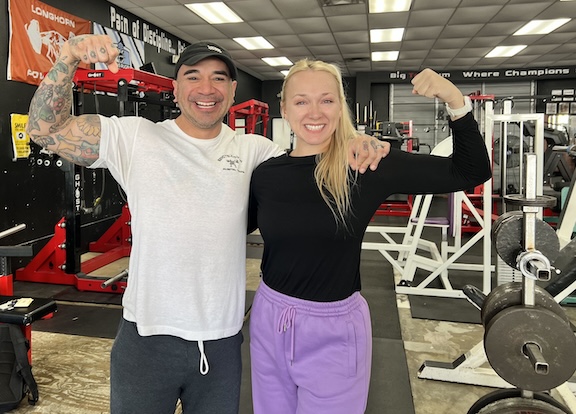
Iron Forge Gym is the collaboration between Rob Impastato & Esther Chou of Big Tex Gym (my favorite gym ❤️ and favorite gym owners ) and streamers Knut, Mizkif and WakeWilder. 

Iron Forge Gym, Round Rock, Texas

Alexander Training (Personal Training) at Iron Forge Gym

I am so happy to announce that I will be taking new clients at Iron Forge Gym! If you are looking for a personal trainer in Round Rock, this is the place for you. I would love to talk to you about your goals and help you make a customized plan.

If you’d like to learn more about me, read about my philosophy here. The gist of it is, I want to help you be as strong and capable and prepared for life as you can be.

Don’t worry; I’ll still be personal training in Austin at Big Tex Gym, too!

Each gym is pretty great, and each has a little different vibe. Both are real, solid training and both have great equipment and facilities.

Check out all your personal training options here.

Kathryn Alexander personal trainer Austin

Please feel free to contact me here about training if you’d like to talk about training at Iron Forge Gym, Big Tex Gym, or online training at your own facility.

Psst, Big Tex made the list of best gyms in Austin.

Strongman Training at Iron Forge Gym

Iron Forge Gym has an impressive strongman training area, complete with turf for sled work, yoke walks, sandbags, and stone medleys. There are loading platforms, logs, circus dumbbells, and the stones from around 75 to 400 pounds will soon live there too. 

The ceiling is high enough for sandbag throws for competitors to practice height over bar throws.

Strongman area at Iron Forge Gym Round Rock, Texas

The Gym Floor

The rest of the gym has a dedicated cardio area with mats and medicine balls for floor work and stretching. 

The main gym floor has platforms, brand new barbells with great knurling (I approve), and plate loaded machines. 

personal trainer Round Rock, Texas Kathryn Alexander

A secondary gym floor has an impressive cable system, racks free weights, and some accessory machines including pull-up stations, 45 degree back extensions and a multi-directional Smith machine. Super rare, and I’ll write a blog post about that machine soon. 

The dumbbells run up to over 120 pounds, and there are barbells in fixed weights too. This is a great place for trainers and their clients. If you’re looking at personal training in Round Rock, Texas, this is where I suggest you start.

And another reason for stopping in: if you go to the gym everyday, sometimes it’s nice to have two gym memberships for some variety.

The Rest of the Gym

The gym is now home to accomplished fighting, muay thai, and mixed martial arts coaches. The first floor of the gym has a large open area for fighting classes. They host a full schedule of classes, which you can get a membership for. 

I love walking in to a great mma class. The fighters are so dedicated and hard working, and I love sharing space with them. 

Iron Forge also has a beautiful studio with wood floors and mirrors. There is a separate posing room as well, with immaculate lighting. 

Kathryn Alexander personal trainer at Iron Forge Gym Round Rock Texas
Kathryn Alexander, personal trainer at Iron Forge Gym Round Rock, Texas

The Lagniappe

Iron Forge is still building out all the extras, but it is rumored there will be a smoothie bar, lounge, cold plunge, infrared saunas, and tanning beds. 

There are men’s and women’s locker rooms that have showers, lockers, and space, which is at a premium in gyms around Austin. Every time I go in the women’s locker room at Iron Forge, it gets cuter. Haven’t been in the men’s in a few weeks and I don’t anticipate going in there again, so I’ll ask my male clients for updates for you. 

The gym is in a shopping center that has plenty of parking (hallelujah!), restaurants, boutiques, and Flix Brewhouse. 

Come Visit Iron Forge Gym in Round Rock, Texas!

Come check it out! Let me know if you’d like to do a consult or a tour. I love helping people get started, so I welcome you to reach out to me. 

And stop by the best new gym in Round Rock, Texas: Iron Forge Gym!

If you’re into local Austin stuff, check out the best parks in Austin, and my favorite fitness things to do in North Austin.

About the author

Kathryn Alexander is a strength coach and personal trainer in Austin, Texas. She loves hiking, college football, and the feel of a perfectly knurled barbell. Read more about Kathryn here.

  • 5 steps to keep fitness progress
    5 Steps To Keep Progressing On Your Fitness Right Now
  • Thanksgiving friends at Big Tex Gym
    Thanksgiving Joy + Fitness Momentum (Yes, Both!)
  • Austin personal trainer Kathryn Alexander shares her clients' secret for successful holidays.
    My Clients’ Secret for Successful Holidays
  • Gifts for powerlifters: wrist wraps
    The Best Gifts for Powerlifters and What 1 Gift to Avoid
  • More Semi-Private Personal Training Options!
  • Quick Note: Exercise is Quality of Life

Filed Under: Austin

The Best Hamstring Strength Exercises for Posterior Work

January 11, 2024 by Kathryn Alexander

The best hamstring strength exercises will build you into a stronger and faster athlete, reduce your risk of injury and knee pain, and make your everyday life all around easier. 

Building strong hamstrings helps with jogging, running, walking upstairs, and decelerating. Hamstrings also play an important role in protecting your knees and lower back from overuse and injury. They are one of the most important muscle groups in the body. 

Continue reading for the the best muscle and strength building hamstrings exercises, including some that are accessible to everybody, and two that are so highly advanced most people can’t do them.

The Hamstring Muscle Group

The hamstring muscles are a group of 3 muscles in the back of the upper leg: the biceps femoris, semitendinosis, and semimembranosus. They are the leg muscles in the back of your legs. Since they cross the hip joint and knee joint, they function to extend the hip and flex the knee.

This means you use your hamstrings in almost every movement you make with your legs, and this is why it is crucial to add hamstring exercises to your strength training.

Why are Hamstrings Important 

Strong hamstrings are important for everyone, and they are vitally important to power athletes. Strong hamstrings especially help athletes decelerate, stop and pivot safely and quickly. 

For everybody, not just athletes, hamstrings that are strong and flexible in the right amounts take pressure off the lower back. 

By using your hamstrings and legs as they are intended to function, instead of relying on your back, you spare the back from overload and injury. 

How to Add These Hamstrings Exercises in Your Workouts

Generally speaking, you’ll want to warm up well, do your main lifts or compound lifts, and then add hamstrings accessory work, in that order. 

This means your first working exercises will be things like squats, deadlifts, and potentially even lunges or step ups. After this, add 2-3 of these exercises to your sessions. You can do 5-12 reps of most of these. That is a big range, but I’ll give more specific guidance with each exercise, and explain how to choose. 

Deadlifts

Deadlifts are a large compound movement which is fairly full body. All deadlift variations involve the hamstrings: the conventional deadlift, stiff leg deadlift, Romanian deadlift, sumo deadlift, etc. 

Conventional and sumo deadlifts also largely use the quads, so they are more of a general lower body exercise; you wouldn’t necessarily call them a hamstring specific movement. However, the Romanian deadlift, B stance RDL’s and stiff leg deadlifts do primarily work the hamstrings.

The Romanian Deadlift

The Romanian Deadlift is the big daddy of hamstring strength! The Romanian deadlift, also called the RDL, is basically a weighted hip hinge, as the main movement is hip extension. It can be done with barbells, dumbbells, a kettlebell, and even a trap bar. The RDL is one of the best hamstring exercises. It can be used for the goal of building strength, or increasing range of motion in tight hamstrings. 

(I get really excited about these because I think these are my favorite hamstring strength exercise.)

Once you get the hinge movement down and really recruit the hamstrings, you can do a good bit of weight here. As always, start with a light to moderate amount. If you get your goal number of reps done well, with good form, increase the weight for the next set. Rest, assess that set, and adjust the weights accordingly for the next set.

RDLs can help hamstring strength, core strength, and even hamstring flexibility.

I like to do heavy RDLs, ranging from 5-8 reps. I recommend leaving 1-2 reps in reserve, as this isn’t an exercise you’ll max out on (even though you can go heavy here).

How to do the RDL: 

  • stand tall with barbell in front of you, feet shoulder-width apart
  • hold the barbell close to your body for the duration of the exercise
  • squeeze your back to keep it straight and neutral
  • push your hips behind you with knees soft
  • let your hamstrings stretch as you lower the weights, keeping them close to your legs
  • at the bottom of the movement, drive your big toes into the ground and push your hips forward (squeeze glutes) until you have returned to your starting position

How to do the RDL with dumbbells: 

  • stand tall with dumbbells in front of you
  • hold the dumbbells close to your body for the duration of the exercise
  • keep your back straight and neutral
  • push your hips behind you with a slight bend in your knees
  • at the bottom of the movement, drive your big toes into the ground and push your hips forward (squeeze glutes) until you are standing tall again
RDL with dumbbells

Stiff leg deadlifts are very similar to RDL’s, except your knees are kept straight for stiff leg deadlifts. These are a little bit less common, and I generally use RDL’s personally and with my clients.

B Stance RDL

The B stance RDL is similar to the RDL except your legs are offset to put more of the weight on one leg. These are very similar to single-leg Romanian deadlifts.Set up similarly to your RDL, and then extend one foot behind you. You’ll pivot off your toes on that foot.

Here’s an in-depth tutorial on how to do the B-stance RDL.

Everything else will stay set up the same: your hips will stay square to the ground (no opening up your hip), and you’ll still hinge your hips back into the movement. The leg behind you is primarily for balance; for example, if you are standing on your right leg with your left leg behind you, your right hamstrings are doing most of the work. 

B stance RDL

The B stance RDL is a great way to work muscle imbalances, as it works your legs mostly individually. 

This one is fun, but is truly a thinker. If you find you have to back off on the weight or video and watch for proper form, that’s totally ok! RDLs in general take some mental work to understand. It is a learning process to understand how to deliberately move some parts of your body while you are holding still others. Don’t be too hard on yourself as you learn this move. 

1 leg Romanian Deadlifts

Good Mornings 

Good mornings are also hip hinges, and the movement looks very similar to the deadlift. The difference is where you hold the weight. Like the RDL, you can do good mornings with a few different implements. You can use barbell, or hold a dumbbell or kettlebell to your chest. However, the good morning is far easier to do with a barbell. 

Because you’re holding the weight higher on your body, you’ll use a lot of core and back strength as you stabilize the bar above your shoulder blades and commence the movement. 

Begin with your feet hip-width apart here, because that’s where you’ll probably feel most stable. There isn’t a hard right or wrong way to do this though, so if you prefer a wider distance between your feet, that’s ok.

For reference, you’ll probably use a lighter weight here than on the RDL. I suggest trying a weight where you can do about 8 reps, 

To do the good morning with a barbell: 

  • grip the bar evenly, and then set up as if you are doing a low bar squat (bar on shoulders, not on your neck)
  • pull the bar into your upper back and shoulders and slightly shrug into it
  • keep your torso tight and neutral, not bending or flexing the spine
  • keeping your whole feet flat on the ground, hinge at the hips and send your hips behind you
  • keep your torso tight and aim to feel a stretch in your hamstrings
  • squeeze your glutes to push your hips back under you
  • return to the standing position and repeat for as many reps as is your goal

To do this with a dumbbell or kettlebell, hug the weight to your chest. All other movements will be the same as with the barbell. 

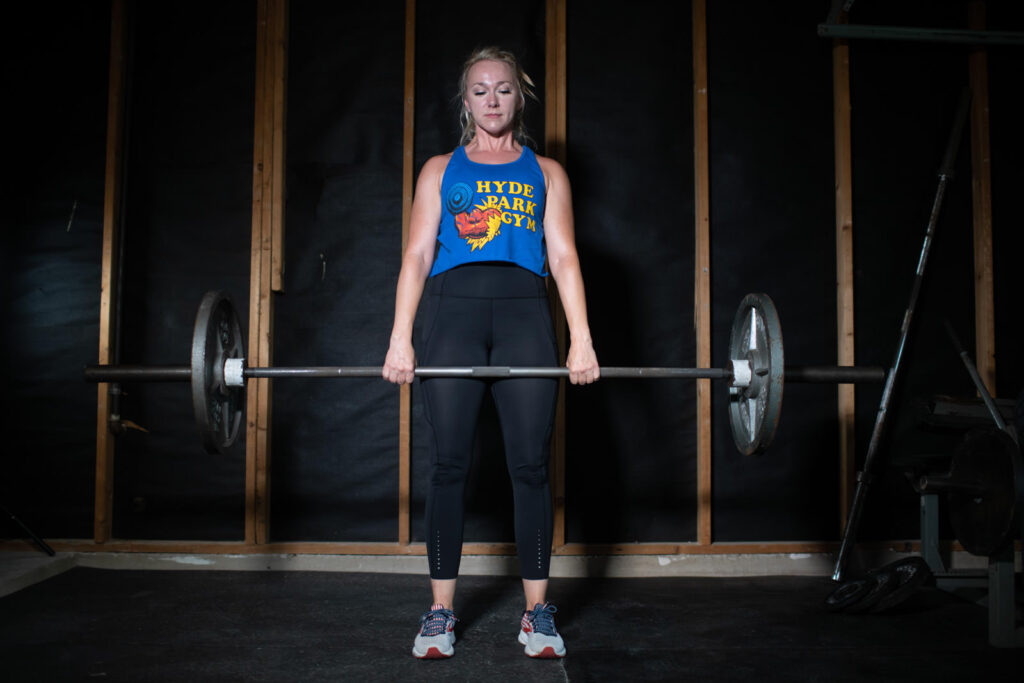
Barbell good mornings from Hyde Park Gym circa 2017
Dumbbell good mornings from my garage gym

The Bulgarian Split Squat

The Bulgarian Split Squat! Also called BSS or rear leg elevated split squat, these are widely beloved; practically everyone’s favorite.* To put it bluntly, these are tough. These also bring in quadriceps more so than the RDL or good morning. They are similar to lunges in that you can change your position to focus more on the anterior (quads) or posterior (hamstrings and glutes). 

*Just kidding, these are infamously not anyone’s favorite.

Bulgarian split squats

I like doing Bulgarian split squats in slightly higher reps. “Like” is a strong word, but these are so challenging that you can’t help but feel victorious after doing them. 

How to do Bulgarian Split Squats:

  • Set up facing away from a sturdy box, chair or bench. 
  • Put one leg behind you, on the box
  • From here, bend both knees to accomplish the split squat
  • Stop before your knee hits the ground
  • Focus on the leg in front to do the work; make sure your whole foot is on the ground
  • Squeeze your glutes, and drive your big toe in the ground as you come up
  • Repeat for as many reps as you are performing
  • Switch legs

If you really want to get these right, here’s a deep dive into how to do the Bulgarian Split Squat.

Tips for the BSS:

  • You can put your toes on the bench, like I do in the video, or put your foot flat on the bench, with the top of your foot resting on the bench.
  • Situate your feet so that there is lateral stability between them. By this I mean, if you were to look down, your feet are as if you are on railroad tracks and not a tightrope. You might have to hop your front foot out to the side to accomplish this. You’ll feel more stable this way. 
  • You’ll probably find one side is more stable than the other. That is ok!

Swiss Ball, Roller, or Stability Ball Hamstring Curl

You can do this style of hamstring curl with anything that allows your feet to move. Unlike many of the other exercises on the list, these are bodyweight exercises.

You’ll start by lying flat on the ground facing up. Place both your right heel and left heel on your roller or stability ball. From here, raise your hips up so your lower torso is off the ground. Then bend knees to pull your heels under your glutes, aiming for a 90-degree angle at the knee.

Towel curls

This is a fantastic exercise for your posterior chain, and easy to do at home. You can even do these with a towel under your heels if you do not have anything with rollers.

You can do these at home! Don’t suffer through a cold gym! Here’s how to heat your garage gym this winter.

This is a great exercise to add into your leg workouts! 

Hamstring Curl Machines

Leg curl machines come in a variety of angles and styles: the lying leg curl machine, standing hamstrings curl machine, and seated leg curl (and a how-to use this Hammer Strength seated leg curl). I LOVE these because they are a fantastic way to get focused attention on the hamstrings. These are usually single joint movements. 

Whether these are prone leg curls (lying face down), seated, or standing, they all involve bending your knee against resistance. Pro tip for setting up a hamstring curl machine: fit your knee joint to about the level of the machine’s joint. If you sit down in a hamstring curl machine and your knee is 5 inches away from where the machine bends, it’ll feel really awkward. This will make more sense once you see a machine in person, but it’s a rule that can help you fit any machine to you. 

Standing hamstring curl machine
Seated hamstring curl machine (Hammer Strength)

These are more focused on the hamstrings muscle group and less taxing on the whole body. For that reason, I like to do these high rep, 8-12 reps. Instead of focusing on how heavy you can go, focus on getting the best squeeze in your hamstrings as possible. 

The name biceps femoris, or biceps of the femur, literally means leg biceps. The femur is the bone in your upper leg. So, as you do these exercises, think of flexing your leg biceps like you would flex your arm for biceps curls. This will help you use these machines best. 

Two of the Toughest Hamstrings Exercises

The Nordic hamstrings curl and the next exercise, the glute ham raise, are two of the most challenging exercises in the gym. They both use your whole body as a lever for the knee to flex against. Knee flexion is these positions is very very tough! On the spectrum from strength to conditioning/cardio, these are definitely hamstring strength exercises.

Nordic Hamstring Curls

The Nordic hamstring curl is done by hooking the heels under something stable and immovable. Your knees will be on a mat or pad. From here, the goal is to keep the body in a straight line from knees to shoulders. A very strong athlete who can complete the Nordic curl will hold this positioning, and lower the body toward the ground in a controlled fashion, and then curl the hamstrings and flex the knee to return the body to the upright position. 

If this is tough, which it likely will be at the beginning, there are many ways to adjust this to be challenging but do-able. One option is to just work the downward motion under control. This is still tough, and I’d like you to be very warmed up before this. 

Another way to modify this movement is to bend at the hips so the level (the body) is not so long, and it’s less force for the hamstrings to work against. 

Finally, you can add a band around the chest pulling upward to offset some of the weight. Similarly, you can use a pole or broomstick as a cane, to press some weight into the ground and assisted on the way up. 

Nordic curls are very challenging! These are one of my favorite hamstring exercises. It’s a good idea to work overall strength and leg strength as you ease into these. 

Since these are so tough, you’ll use these as a traditional hamstring strength exercise and likely do lower reps of 3-5, rather than 10+.

Glute Ham Raise

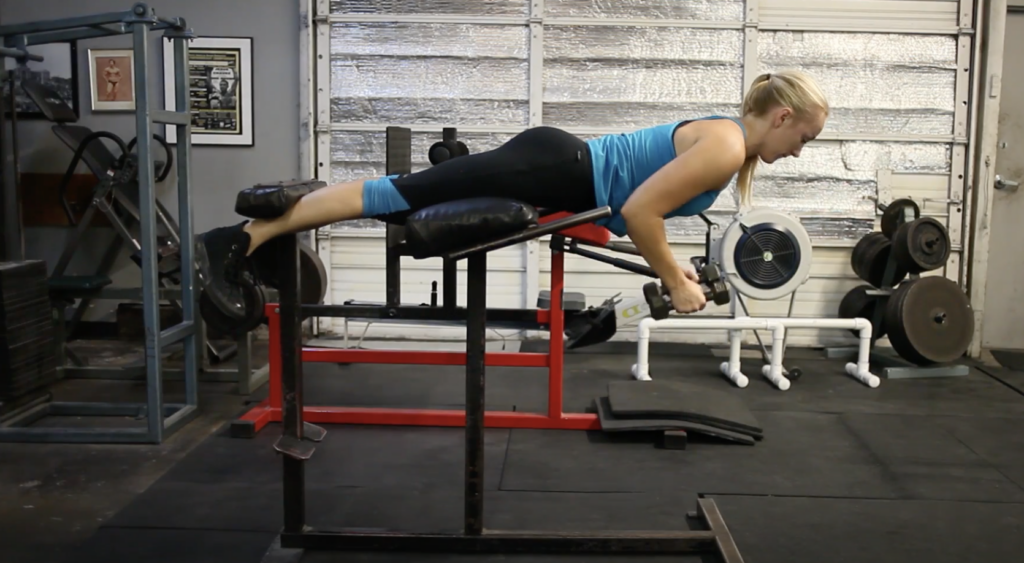
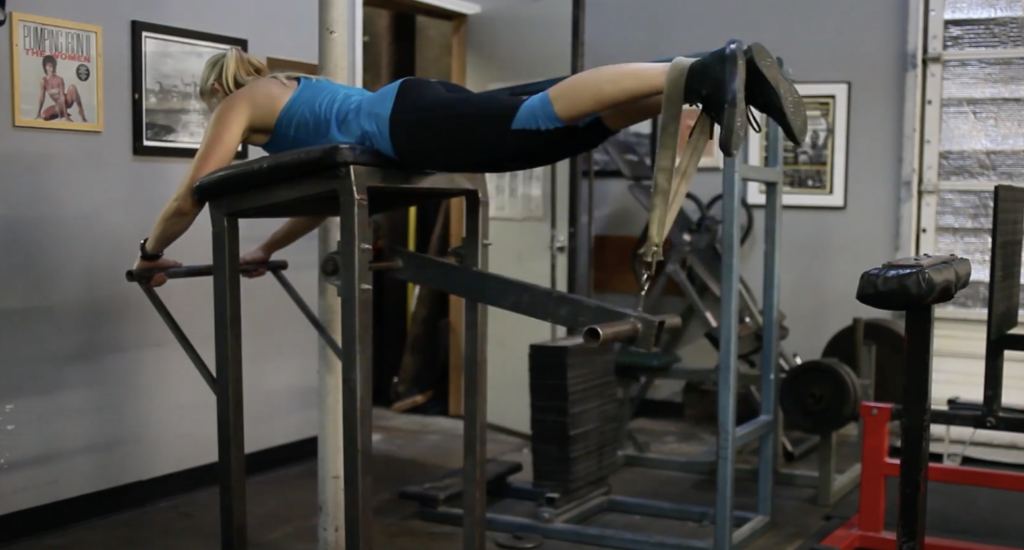
The glute ham raise is also very difficult because it uses the lifter’s whole body weight as the lever. You begin in the glute ham raise machine by setting up similarly to how you would for the back extension: prone, facing the floor, back of your thighs facing upward, and with feet hooked under the machine’s pads. 

From here, you attempt to keep your whole body straight by keeping your torso tight and glutes tight. Flex hard at the knees until you are in an upright position. 

This can be modified to be more achievable by bending at the hip to shorten the lever, or using a broomstick/pvc pipe as an aid. 

Like the Nordic curls, you’ll probably do low reps here.

What Else Works the Hamstrings?

Most compound lower body movements work the hamstrings. Walking, jogging, running, doing kettlebell swings, squats, lunges, lateral lunges, step ups, hip thrusts all work the hamstrings.

Here are some other great exercises for strengthening your posterior: best machines for the lower back.

Unless you are trying very hard to isolate your quads, you’ll use your hamstrings anytime you do leg exercises or a lower-body workout. Weak hamstrings are more susceptible to injury, so be sure to add a good amount of lower body work to your strength training program.

In addition to the hamstrings specific work, you’ll definitely want to work quads and glutes. Here’s a complete lower body workout, which you can do at home.

How to do Hamstrings Workouts

Like I mentioned in the intro, to incorporate hamstrings into your leg day, I suggest getting a through warm up. For the best results, do 1 or 2 compound movements such as the deadlift or squat early in your session when you are freshest. After that, add in isolation exercises like leg curl machines, and assistance exercises like the ones listed above. 

If you need specific and custom programming, I would love to talk about working together. Message me here!

About the author

Kathryn Alexander is a strength coach and personal trainer in Austin, Texas. She loves hiking, college football, and the feel of a perfectly knurled barbell. Read more about Kathryn here.

  • 5 steps to keep fitness progress
    5 Steps To Keep Progressing On Your Fitness Right Now
  • Thanksgiving friends at Big Tex Gym
    Thanksgiving Joy + Fitness Momentum (Yes, Both!)
  • Austin personal trainer Kathryn Alexander shares her clients' secret for successful holidays.
    My Clients’ Secret for Successful Holidays
  • Gifts for powerlifters: wrist wraps
    The Best Gifts for Powerlifters and What 1 Gift to Avoid
  • More Semi-Private Personal Training Options!
  • Quick Note: Exercise is Quality of Life

Filed Under: How To

How to Make and Keep New Year Fitness Resolutions

December 30, 2023 by Kathryn Alexander

Happy New Year! Learn how to make and keep New Year fitness resolutions in this quick read.

Are you making New Year fitness resolutions this year? If so, I love this for you! It’s a great time of year to use all the optimism and the feeling of a fresh start to keep reaching for your goals. 

I was first certified as a personal trainer 19 years ago. Whoa, time flies! In this time, I’ve seen hundreds of people make plans, make resolutions, make goals, work toward their goals, fail and succeed. 

Personal trainer Austin; Kathryn Alexander wants to help you hit your New year fitness resolutions
I want to help you make and keep your New Year fitness resolutions!

The ones who have succeeded in reaching their goals have done a few things right. Read below for how to use these tips on how to make and keep your new year fitness resolutions. 

Resolutions and Goals Work Together

One thing I want you to keep in mind is that resolutions and goals are not the same thing. Goals are the outcome of your resolutions.

Resolutions are the actions you take to get to your goals, and without resolutions, your goals are dead in the water. Likewise, it is much harder to consistently hit your resolutions if you don’t have goals to push toward.

Read below to find out what my clients and I have discovered about how to make your resolutions work for you, and drive you toward your goals!

Think About Your End Goal – Dream Big! 

First I want you to think about what you really want. If you could achieve what you want most, what is it? Don’t be practical, don’t be pessimistic. What do you want??

DON’T shoot your ideas down! Think about your biggest, highest, loftiest goals! Don’t overanalyze how long it’ll take or even if you can do it. Just be honest with yourself about what you’d like. 

Make and keep new year fitness resolutions
Write down your goals to make and keep new year fitness resolutions!

You can pare it down later if its too crazy, but for now, think big!

Interestingly, I often find that thinking big and being honest about goals is a difficult thing for people to do. Nobody needs to give you permission to want what you want. You deserve to be happy in the body you life, so be honest about what that is. 

You can decide later if it’s something you want enough to pursue. For now, just think about those goals.

For example, I want a 315 deadlift, a 150 pound bench and a 250 squat. We’ll continue to use this example of a big New Year goal.

Your goal can be an outcome or an event; it can be to lose a certain amount of weight or do a 5k. It can be anything.

Pick One of These Goals to Work On

I hope you really did think big and choose a few goals. For now, let’s pick one to focus on.  Which one seems most exciting or rewarding for you to choose? Which do you feel like you can work consistently at?

I’m going to focus on my deadlift for a few reasons. 1, I’ve been making progress toward it more than my other lifts. 2, my squat is farther away from my goal than my deadlift. 3, bench, ugh. 


Can I help you reach your fitness goals this year? Check out these training options for working together, and email me to discuss your free consult!

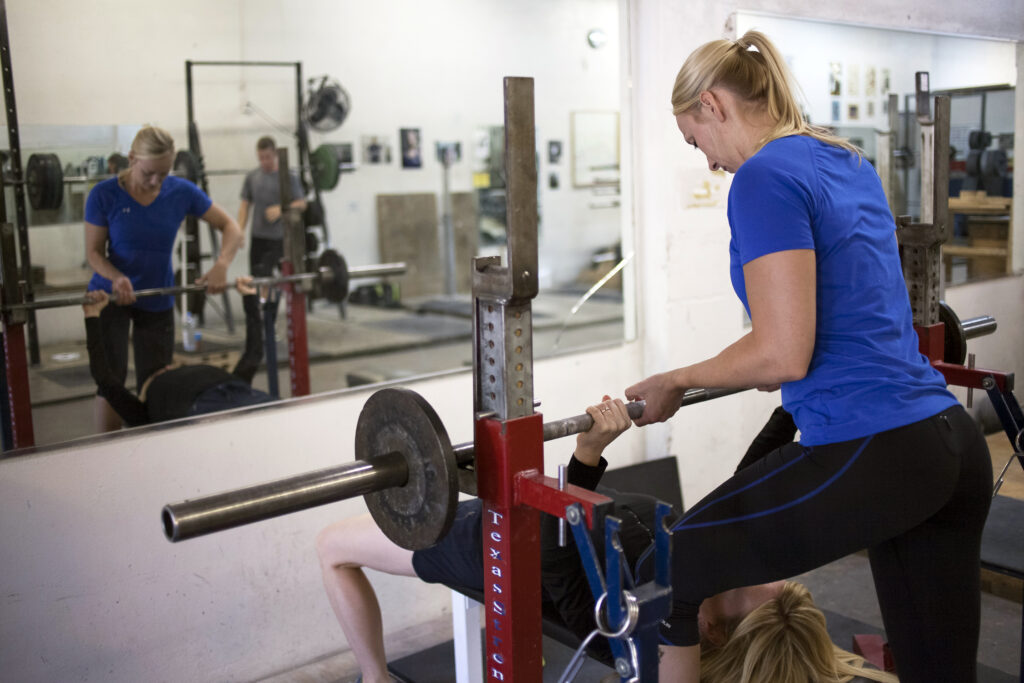
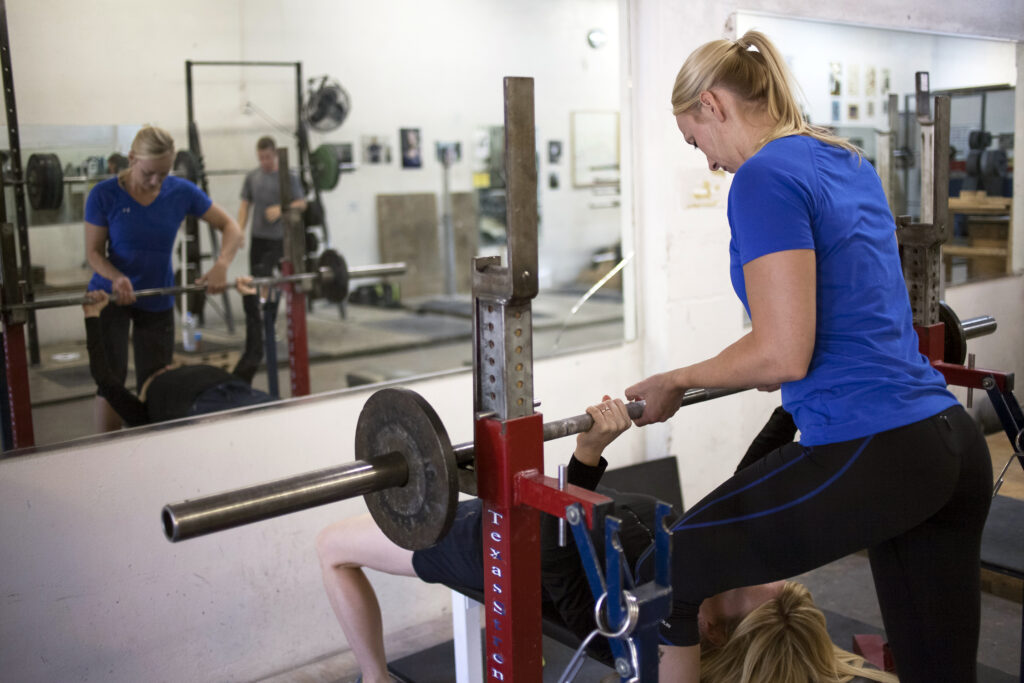
Austin personal trainer Kathryn Alexander spots a client on the bench press.

Make Your Goal Achievable (Probably)

Now I’ll let you think about if this is feasible, and if you want it. First, is this achievable for you, or inside the realm of possibility? At this point, don’t be pessimistic, but you can be reasonable here. 

For example, if I’m telling the truth, I want a 500 pound deadlift, not just a 315 pound one. Haha. Honestly, that’s probably not possible for me. I’ll choose a more achievable goal. Plenty of women my size and age have deadlifted 315. I’m certain if I train hard and eat and rest enough, I can deadlift 315.

The second part of identifying this goal is deciding if it’s worth working on. Are you willing to put in the effort to achieve it? Sometimes a goal is absolutely doable, but will take more effort than you’re willing to exert. 

new year resolutions and goals for a big deadlift
A 315 deadlift is my new year goal!

Like I mentioned before, many women like me have deadlifted 315. Many have deadlifted significantly more. I think it would take more effort training, and weight gaining than I’m willing to do to deadlift much more than 315. I’d be super proud with 315, so I’ll choose that.

What one goal can you work on that sets you up to be happy and proud when you work toward and achieve it?

Reverse Engineer – How Can You Get Halfway To Your Big Goal?

This is important! Where would you be if you make it halfway to your goal? How can you make it there? This can be losing a certain number of pounds, jogging half your goal mileage, etc. 

For me, I need about 75 pounds more on my deadlift to reach 315. Halfway to that goal is about 37 pounds added to my deadlift. I can do that. That will take some months, and a steady supply of lifting, eating enough, and resting. It might not even happy this year, but I can work on it. The time will pass anyway.

Identify your halfway point and estimate about how long that will take you. Does this still support your idea the goal being one you are willing to work toward?

If so, congrats! If not, make an adjustment until you’re confident that both your halfway, and whole goal are most likely achievable. Even if they’re a bit aggressive, know that with hard, deliberate and consistent work, you can get pretty darn close to achieving it.

Identify Resolutions to Take You To Your Goal

What action steps can you take to drive you toward your goal? Brainstorm these. Write them all down and we’ll condense them into an actionable plan. 

These will become your resolutions. 

My brainstorm: 

  1. Do a heavy (not max) deadlift every 7-10 days.
  2. Practice well chosen accessory work
  3. Prioritize getting enough quality sleep
  4. Quit skipping breakfast, Kathryn. Eat breakfast every day! 

As a side note, you can skip breakfast if it works for you. Meal timing, preferences and amounts of macronutrients are different for everybody. This is completely dependent on your goals, style of training, what time of day you train and eat, etc. I just know that for myself, I don’t tend to eat enough if I skip breakfast.

Choose Your Resolutions

Finally, you can now choose your resolutions! Choose one or two main ones that you are 95% certain you can achieve. It is always better to consistently keep your word to yourself on one or two main action items than to fail at 12 perfect action items.

For my deadlift goal, I made 4 potential action steps. I am going to choose two of those to be my resolutions: am going to choose prioritizing sleep and breakfast as my resolutions. 

I chose this because these are not things I do well and regularly. Added focus on sleep and breakfast is where I can make the most progress. 

I am certain I can manage my time better to do both of these things. 

The reason I didn’t choose deadlifting weekly and doing good accessory work is because I am currently doing those two things. Those aren’t things that are a problem for me, so I don’t need the extra focus of calling them new resolutions.

Solidify Your Resolutions

Add detail to your resolutions so you know exactly what you have to do to achieve them. Have a concrete idea of how to execute them. Don’t make them nebulous gray area. 

Think through the details so you can be certain when you are setting yourself up to succeed.

For example, I said I need to get enough sleep. What does that even mean? For me, that means 8 hours. I don’t have a problem getting that on weekends, so I’ll focus on getting enough sleep on weeknights.

Secondly, I mentioned eating breakfast. That means protein and a side, and giving myself a few more minutes in the morning so lack of time is not an excuse. I’ll have to be honest with myself about what I’ll make enough time to eat in the morning. 

My goal is 30 grams of protein for breakfast, and a side or two. I can do this through eggs, Greek yogurt and fruit.

So there we have it: my new years resolutions are to sleep 8 hours on weeknights. Second resolution is to have 30 grams of protein for breakfast every morning. 

How Will You Achieve These Resolutions? 

Add more detail to the following section and think through these resolutions. To support these resolutions, I need to focus on getting all my work done earlier in the day so I do not have to work late past bedtime. 

To hit my breakfast goals, I’ll need to keep fresh eggs, fruit and yogurt in the fridge. I’ve never been worried about eating “non breakfast” foods for breakfast, so I sometimes fall in the habit of not preparing well, assuming I’ll just grab leftovers.

But, to make my resolutions, I’ll have to keep the fridge stocked.

Do you need motivation? Here are my 53 favorite motivational gym quotes.

Are you looking for personal training in Round Rock, Texas? Here’s a great place to start!

What Are Your Resolution? 

I’d love to hear your resolutions for 2024! Message me or leave them in the comments below. 

Remember these easy steps to make and keep new years fitness resolutions:

  • Identify your goals and prioritize one
  • Choose resolutions that will help you achieve that goal
  • Put a plan in action to succeed on those resolutions 

Questions About How to Make and Keep New Years Fitness Resolutions:

Shouldn’t I Make More Resolutions? I Need to Change More than 1-2 Things!

No! Pick 1 or 2. Nail them. Hit it out of the park. Crush it! Then after a month or a quarter, you can add in another 1 or 2 resolutions. It is much less likely you achieve any success if you’re trying to change 27 things at once.

I Blew it On Day 1. What Do I Do?

Just start new! It’s hard to not celebrate at the new year; it’s fun! Just restart, and recommit; don’t look back.

Related: How Does Alcohol Affect Gains?

How Long Should New Year Resolutions Last?

This might sound like a silly question, but it’s a fair one to ask.

Not all new year resolutions stick, and that’s ok. Some aren’t made to last forever. If it stops you from making resolutions because you think they can’t last all year, try for some January resolutions. 

Run through the above exercise with a goal of making resolutions you can keep just for one month. After that, you can edit them or maintain them, or even completely rethink them. 

I always encourage a long outlook, but if you need to do a quick push, read here about how to successfully do a 1 month body transformation.

Turns out, I’ve had the same philosophy about new year’s resolutions since I wrote about them in 2015. Ha!

About the author

Kathryn Alexander is a strength coach and personal trainer in Austin, Texas. She loves hiking, college football, and the feel of a perfectly knurled barbell. Read more about Kathryn here.


  • 5 steps to keep fitness progress
    5 Steps To Keep Progressing On Your Fitness Right Now
  • Thanksgiving friends at Big Tex Gym
    Thanksgiving Joy + Fitness Momentum (Yes, Both!)
  • Austin personal trainer Kathryn Alexander shares her clients' secret for successful holidays.
    My Clients’ Secret for Successful Holidays
  • Gifts for powerlifters: wrist wraps
    The Best Gifts for Powerlifters and What 1 Gift to Avoid
  • More Semi-Private Personal Training Options!
  • Quick Note: Exercise is Quality of Life

Filed Under: Attitude & Mindset

The 5 Best Parks in Austin for Outdoor Recreation (2023)

October 9, 2023 by Kathryn Alexander

Just in time for cooler weather (hallelujah!), I present to you the 5 best parks in Austin for outdoor recreation. Austin is a beautiful city that does an excellent job of prioritizing parks, green space, and walking trails. It is a great place to balance gym life and the great outdoors.

We all know that movement is healthy for our bodies, and so is being in the outdoors. Combine the two, and you can reap the benefits of the sunshine and Vitamin D, healthy fresh air from the green trees, and movement in the open space, away from computers and Zoom calls. 

Getting outside is a perfect supplement to your gym training. You can walk, hike or swim as an active recovery between lifting days, or you can use this as cardio. Or, my favorite, just get outside and play and be happy.

For this holiday season: read the ultimate gift guide for powerlifters. Or if you’re wanting to spread local cheer, the ultimate Austin Gift Guide (2024).

Check out these places below, and you’ll find the perfect place to refresh your day, and spend some time in the great outdoors. 

Best parks in Austin for outdoor recreation (Zilker Park)

Zilker Park

Zilker Park is hands down the best park in Austin. Formally called Zilker Metropolitan Park, Zilker Park is located in the heart of Austin. It is just on the south side of Lady Bird Lake, and covers 351 acres of lawn, trails and trees.

Zilker Park has an expansive green space that allows for kite flying, picnicking, off-leash dog frolicking. There are picnic tables, volleyball courts, and trails for walking and hiking, and a disc golf course, all with a great view of downtown Austin.

Zilker Park is a great spot to bring a blanket and tennis shoes and get some outdoor exercise in. You can run, jump, do lunges, pushups, or stretch and meditate. and K LINK minimal or bodyweight exercise links. 

Zilker is also the location for great events such as Blues on the Green, the Austin Kite Festival, and the world famous Austin City Limits Music Festival.

The property also contains my favorite place in Austin, Barton Springs Pool, and the Zilker Botanical Garden. Barton Springs Pool is a chilly 68-70 degrees year round. It’ll give you a pep in your step when you get out of the water! Barton Springs Pool has an admission fee of $5 – $9, and veterans get in free.

Barton Springs Pool in Zilker Park in Austin, Texas

Zilker Botanical Garden is a 28 acre gorgeously maintained property with live oaks, water features and koi ponds. Parking is free in the small parking lot, and admission is $5-$7.

Outside of the botanical garden, parking is abundant at Zilker Park, but it still gets crazy busy. Parking is $7 on weekends, holidays, and special events. 

Address of Zilker Park:

2100 Barton Springs Rd.
Austin, TX 78704

Anna & Roy Butler Hike and Bike Trail and Boardwalk

Covering 10.1 miles around Lady Bird Lake, the Anna & Roy Butler Hike and Bike Trail and Boardwalk is a hike and bike path designed for non-motorized traffic. There are shorter versions of the trail if you cross at the Lamar Street Bridge, South First Street, Congress Avenue, or the pedestrian bridge. The far east part of the trail reaches to Krieg Fields, which is a recreation complex that has sand volleyball courts and softball fields. 

There is not one specific address, as the trails cover so many miles around Lady Bird Lake. Some parking options include the lot at Auditorium Shores, street parking on S. Lakeshore Blvd, or lot and street parking near Austin High School. 

Address of the Anna & Roy Butler Hike and Bike Trail and Boardwalk:

Parking near Austin High School, located approximately at

1900 Stephen F. Austin Dr.
Austin TX 78703

Downtown skyline from Lady Bird Lake (Town Lake) in Austin, Texas

Mueller Lake Park

Mueller Lake Park is a very modern park in east Austin, at the site of the former Mueller Airport. The park contains walking and biking trails and green space that surround a 6.5 acre pond. There is an open-air amphitheater, interactive playscape for the kids, and food trucks for if you need refreshment. The open green space is a perfect spot to set up a yoga mat or picnic blanket, and do some snacking and stretching.   

As a sidenote, just across the street from Mueller Lake Park is the Pharr Tennis Center, which has tennis courts and a small walking trail. 

Address of Mueller Lake Park:

4550 Mueller Blvd.
Austin, TX 78723

Auditorium Shores

Auditorium Shores is a beautiful park located downtown, also along the banks of Lady Bird Lake. Auditorium Shores includes a large open area where running groups, outdoor boot camps and solo exercisers mix. Close to the water is a barebones outdoor gym which includes a slant board for ab work, pull-up bars, and parallel bars. 

If you’re there to relax instead of exercise, bring the pup and a snack. Much of the lawn is an off leash dog park, and there are abundant places to set up a picnic area. Another great option for exercising at Auditorium Shores is to combine some bodyweight exercises with a walk around Town Lake (Lady Bird Lake), as this is a great access point to the hiking trail.

Address of Auditorium Shores at Town Lake Metro Park:

800 W Riverside Dr.
Austin, TX 78704

Barton Creek Greenbelt Trail

The Barton Creek Greenbelt Trailhttps://www.austintexas.gov/department/barton-creek-greenbelt is 12-14 miles of trails that encompass many other popular trails in South Austin. The trailhead is located near Barton Springs Pool in Zilker Park, and continues through the Violet Crown Trail, Twin Falls, Sculpture Falls, and Hill of Life at the trail’s end. This trail ranges from flat and wide to rocky with a small grade. 

Hiking the entirely of this trail will take 4.5 – 6 hours or more, so be prepared with hiking shoes and water. You can break this hike into parts, by just hiking the Violet Crown Trail, or just to Twin Falls and back, if you’d rather a shorter time and distance commitment.

Note that when Austin has had adequate rain, you’ll see a good bit of water and some waterfalls on this hike. It won’t always be flowing, depending on recent rainfall. I recommend checking AllTrails K LINK for recent reviews if choosing hikes with waterfalls in Austin is important to you. 

On the list of best parks in Austin for outdoor recreation, this might be the best!

There are several access points, including a couple in neighborhoods. Below are the trailhead and trail’s end addresses. 

Address of Barton Creek Greenbelt Trail:

Trailhead:

2212 William Barton Dr.
Austin, TX 78746

Trail’s end:

1710 Camp Craft Road
Austin, TX 78746

Best Parks in Austin

If you are looking for something specific like basketball courts, a splash pad, baseball fields or a soccer field, you might have to do some other googling. In the meantime, check out the above 5 best parks in Austin for outdoor recreation. Let me know which ones you love, and which I need to check out! 

Related: Best Gyms in Austin, Texas and best restaurants in the Domain if outdoor recreation is not for you. While you’re at it, check out the newest gym in Round Rock, Texas. This place is awesome!

Is Personal Training in Austin on Your Bucket List?

Yes I know, I use bucket list incorrectly. I just think something as good as worthy of being on a bucket list, is worth doing more than once!

If you are looking for personal training in Austin, I’d be so happy to do a free consult with you and discuss goals and options for you. Check out this page about personal training details and leave me a message about how I can help you!


About the author

Kathryn Alexander is a strength coach and personal trainer in Austin, Texas. She loves hiking, college football, and the feel of a perfectly knurled barbell. Read more about Kathryn here.


  • 5 steps to keep fitness progress
    5 Steps To Keep Progressing On Your Fitness Right Now
  • Thanksgiving friends at Big Tex Gym
    Thanksgiving Joy + Fitness Momentum (Yes, Both!)
  • Austin personal trainer Kathryn Alexander shares her clients' secret for successful holidays.
    My Clients’ Secret for Successful Holidays
  • Gifts for powerlifters: wrist wraps
    The Best Gifts for Powerlifters and What 1 Gift to Avoid
  • More Semi-Private Personal Training Options!
  • Quick Note: Exercise is Quality of Life

Filed Under: Austin Tagged With: Austin

The Best Exercise Machines for Lower Back Strength

September 7, 2023 by Kathryn Alexander

The best exercise machines for lower back strength will build muscular strength and endurance, encourage good posture, and help prevent lower back pain. Fortunately, these machines and exercises are widely available at gyms, so you can build a resilient and strong back for life.

People have many misconceptions about back exercises and what actually causes back pain. Sadly, in an effort to avoid back pain, many people choose to avoid the best exercises to build back strength, which is actually what will protect the back from pain and dysfunction.

To optimally work the lower back, you’ll want to use some of the best exercise equipment and some bodyweight exercises. Let’s cover these in detail so you can build your back strength the right way.

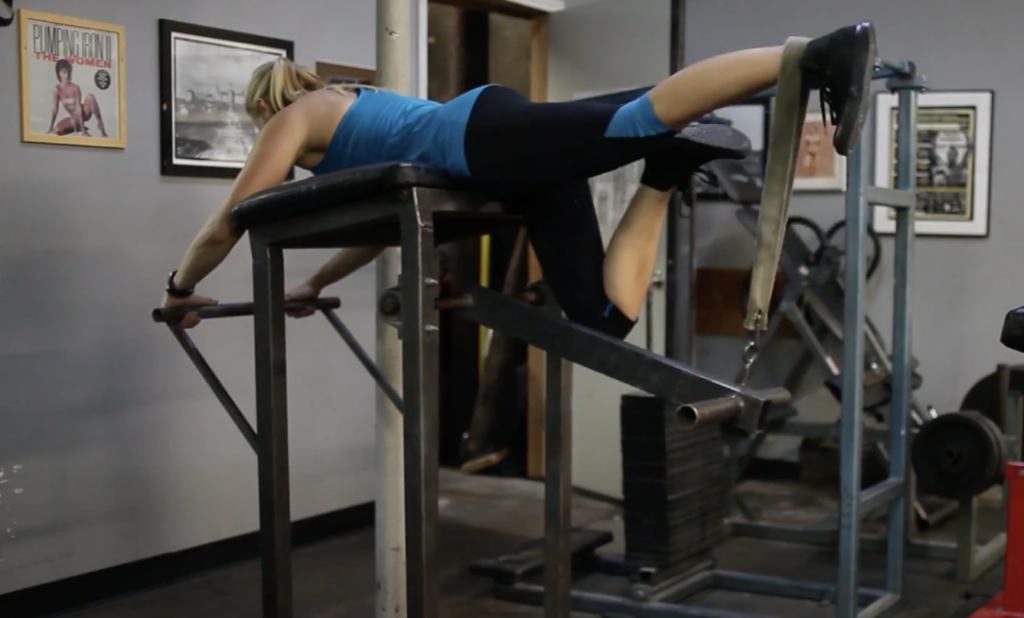
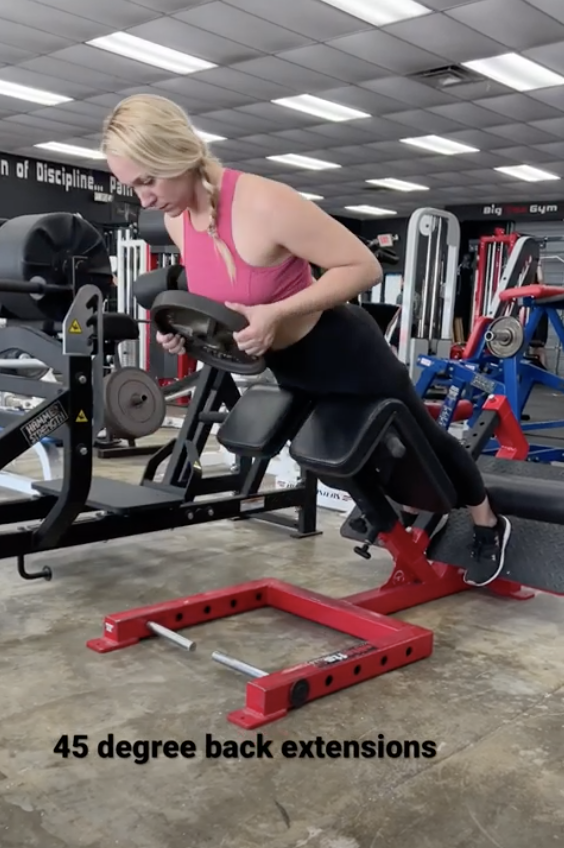
exercise machines for lower back - back extension
The back extension – one of the best exercise machines for lower back strength

Misconceptions About Working the Lower Back Muscles

Often, people treat any sensation in the low back with concern, avoiding all feeling in the low back at all costs. The truth is, your lower back is made of muscle just like any other muscle group. Among the lower back muscles are the erector spinea, the muscles that run vertically along your spine.

Train Your Lower Back Like You Do Other Muscles

When you train your erector spinae, they will feel fatigue and muscular soreness, just like you would feel your biceps if you did curls, or your abs if you did crunches. 

You need to train your lower back muscles like you train your other muscles. You should feel flexion and extension through your movements, and that is ok! 

Back Injury Does Not Equal Chronic Low Back Pain

People also think having a “bad back” is a curse for life. Sure, back issues are no joke and the possibility of chronic back pain is terrifying. But, the back can heal. Depending on the severity, a doctor, physical therapist and/or personal trainer can help develop a training plan or exercise routine that can take steps toward healing the back.

For instance, herniated discs are extremely common in the area of the lumbar spine. This is not a lifetime sentence! Herniated discs can heal, on their own without surgery.

The Harvard Medical School reports that 90% of pain related to a herniated disc will dissipate on its own within 6 months.

Remember, the body wants to heal itself. Blood flow and movement are good and facilitate healing, both in healthy and (most) injured situations. Obviously, please don’t go do back extensions in an emergent situation.

Your Back Is Not Fragile!

I repeat: your back is not fragile! The spine is made of 33 individual vertebra because it is MADE to articulate. It’s function is to move, and to support your movement! Of course, I hope your workout routine includes the right exercises for you and your goals, and I hope you employ proper form especially as you gain strength. 

A strong back can withstand load, impact and movement. Please do not be scared of moving your back!

Why is Lower Back Work Important?

The last misconception that people have, and often the most dangerous one, is akin to thinking that running is enough training for the lower body. Many people skip building strength in their legs because they get on the elliptical trainer, recumbent bike, or cover ground outside. 

That is not enough leg work! The lower body needs strength training, like the upper body. Strength training is not aerobic exercise.

Similarly, people often think that the elliptical machines, step machines, stationary bikes or other full body type cardio exercises are good enough back work. They simply do not build the kind of back strength and core strength that you need. 

Aerobic exercise is not a bad form of exercise; in fact, cardio has many documented and undeniable health benefits. It’s just a different form of exercise. For best results, back strength is worked by resistance training. 

Just like you work other muscle groups, you need to directly work lower back.

You might have heard that sit ups can be tough on the lower back. It’s true. Here are some alternatives to sit ups.

What Exercise Machines Are Good for the Lower Back? 

The best lower back machine works your posterior chain, meaning your glutes, hamstrings and back. Some of the best lower back machines are: 

  • back extension machine
  • reverse hyperextension
  • good morning machine by Matt Wenning 
  • Back Attack by Sorinex

All of these allow extension at the hip and coordination with the erector spinae, glutes, and hamstrings. 

How to Use Back Extension Machine

The back extension machine is mostly commonly seen as the 45 degree back extension. It’s the lesser intimidating one to start with. I actually love the horizontal back extension so much, I bought one for my garage. Both are fantastic exercise machines for your lower back, glutes and hamstrings! 

  • To perform the back extension, adjust the machine so that your hips can fold over the edge of the padding. 
  • Get situated on the machine with your heels snug against the pad behind your ankles. This is important. 
  • From here, hinge at the hip joint instead of bending in your back. 
  • Hinge at the hip joint to fold down, feeling the stretch in your hamstrings. 
  • Squeeze your glutes to return to your start position. 
  • To increase the challenge, you can hold a weight at your chest. If you aren’t there yet, just cross your arms across your chest. 

Heres a whole tutorial on the back extension.

How to do the Reverse Hyperextension

The reverse hyperextension is one of my favorite machines ever. It was invented by Louie Simmons of Westside Barbell. The reverse hyperextension is starting to make it’s way to commercial gyms, but it’s not as common yet. 

Here is how to use the reverse hyperextension: 

  • Step up and situation yourself on top of the machine.
  • Scoot back to where the end of the machine is between your hip bones and pubic bone. If you are familiar with your snatch grip, this is where the bar contacts your body. 
  • From here, hold the handles for stability and let your lower body hang off the machine at 90 degrees.
  • Keeping your quads on (knees straight), squeeze your glutes to make a big sweeping movement with your legs.
  • Return your legs to your start position. 
  • If you are doing this with weights, you can use a bit of momentum. You’ll still want to press your legs hard against the rope and squeeze your glutes at the top of the movement. 
  • Repeat for as many reps as is your goal.
Austin personal trainer Kathryn Alexander on reverse hyperextension - exercise machine for lower back
reverse hyperextension – maybe the best exercise machine for lower back!
1 leg reverse hyperextension machine for lower back
1 leg reverse hyperextension rep. You can do both legs together or one at a time.

How to Use The Good Morning Machine by Matt Wenning

  • Stand on the platform with your thighs making solid contact with the pad in front of you. 
  • Stand with your heels firmly against the pad behind your feet.
  • Set your upper back against the pad, and brace your torso so you are ready to receive the weight.
  • Unhook the weight pins with both arms.
  • Hinge forward, being sure to perform the movement as a hinge.

How to Use The Back Attack Machine by Sorinex

  • Stand on the platform with your thighs making solid contact with the pad in front of you. 
  • Stand with your ankles snug against the rollers behind them.
  • Set your upper back against the pad, and brace your torso so you are ready to receive the weight.
  • Unhook the weight pins with both arms.
  • Hinge forward, being sure to perform the movement as a hinge, like the good morning machine.

How to Add These Machines Into Your Training

Try these when you are warmed up and feeling good. I suggest doing your big lifts like squats and deadlifts before these. These will be accessory work to do before you finish your training session. 

Begin with an easy set of 8-12 repetitions. If it’s super light, increase the weight slightly. Continue doing this until you reach a good working weight. Use these lighter sets to feel and understand the exercise. 

What Other Back Exercises Should You Do?

Of course, begin by trying these exercise machines for lower back training. For best health and strength results, you’ll want to work your whole back, including your upper back as well. This is an entirely separate post (to be written!) but the synopsis is that a full back session, not just lower back, will include exercises for the latissimus dorsi, rhomboids, trapezius muscle group, rotator cuff, and rear deltoids.

The best exercises and machines for these muscle groups are: 

  • Lat pulldowns
  • Pullups or assisted pull-up machine work
  • Barbell rows
  • Rope pulls (face pulls)
  • Seated rows
  • Dumbbell rows

Try These Machines 

Add these machines into your training program, and let me know how they go! I love hearing about your training, and what you enjoy, what works, what doesn’t. Give me all the feedback! 

If I can help you plan your training or help with your fitness, please let me know! 

Related Reading

Best exercises for rear delts

How to address lower back pain from squats

It’s not a machine per se, but learn about cable squats muscles worked, and how to include them in your leg day.


About the author

Kathryn Alexander is a strength coach and personal trainer in Austin, Texas. She loves hiking, college football, and the feel of a perfectly knurled barbell. Read more about Kathryn here.

  • 5 steps to keep fitness progress
    5 Steps To Keep Progressing On Your Fitness Right Now
  • Thanksgiving friends at Big Tex Gym
    Thanksgiving Joy + Fitness Momentum (Yes, Both!)
  • Austin personal trainer Kathryn Alexander shares her clients' secret for successful holidays.
    My Clients’ Secret for Successful Holidays
  • Gifts for powerlifters: wrist wraps
    The Best Gifts for Powerlifters and What 1 Gift to Avoid
  • More Semi-Private Personal Training Options!
  • Quick Note: Exercise is Quality of Life

Filed Under: Training

Best Rear Delt Exercises: Strengthening Your Shoulders

August 23, 2023 by Kathryn Alexander

It is so important to work rear delts (deltoids), because they, like back muscles, often get overlooked for muscles that we can see. Our biceps are easy to spot, our pecs are fun to work, and everyone can agree about putting more ab work on the program. The best rear delt exercises can supplement all of those movements!

best rest delt exercises

But rear delts? We have to go out of our way to prioritize them. Pushups, dumbbell presses and bench presses work anterior delts more than rear delts. If we push more than we pull, we can create an imbalance that sets shoulders up for injury, or at least, decreased performance. 

Rear delts are crucial to work, though, because they are an essential part of the upper body and play a important role in shoulder mobility and stability. Neglecting the rear deltoids can lead to muscle imbalances and potential injuries.

Incorporating rear deltoid exercises into your workout routine can help improve posture and prevent shoulder injuries. In this article, we will discuss some of the best exercises that target the rear deltoid muscles. 

These exercises can be done with or without equipment and should be incorporate by all, from beginners to advanced lifters. By including these exercises in your routine, you can ensure that your rear deltoids are getting the attention they deserve, leading to a stronger and healthier upper body.

Need a balanced program, which includes rear delts, and other often neglected muscle groups? Check out my training programs which you can jump into now.

Understanding Rear Delt Muscles

The rear deltoids, or posterior deltoids, are one of the three muscle groups that make up the deltoids, or shoulders. The rear deltoids are located on the back of the shoulder and are responsible for shoulder extension and external rotation. In other words, they move the arm backwards and rotate the arm out.

Facepulls, one of the best rear delt exercises

Importance of Rear Delt Exercises

Rear delts are highly involved in most upper body pulling, which is an essential movement for various daily activities such as pulling a door, carrying a backpack, or even throwing a ball.

Neglecting the rear delts can lead to muscle imbalances, which can cause shoulder pain and increase the risk of injuries. Including rear delt exercises in your workout routine is essential for maintaining good posture, reducing the risk of injuries, and improving your overall athletic performance.

Benefits of Rear Delt Exercises

Strengthening the rear delts can improve your posture, reduce the risk of injuries, and increase performance in other exercises such as the bench press, overhead press, and pull-ups.

Incorporating rear delt exercises into your workout routine can help you achieve a well-rounded and balanced physique. It can also enhance your overall athletic performance and

Improved Posture

Rear delt exercises can help improve your posture by strengthening the muscles that support your shoulder blades. When these muscles are weak, your shoulders can round forward, leading to a hunched posture. By strengthening the rear deltoids, you can help pull your shoulders back and improve your posture.

Reduced Risk of Shoulder Injuries

Strong rear deltoids can help reduce the risk of shoulder injuries. When the rear deltoids are weak, the front of the shoulder can become overworked, leading to imbalances and potential injuries. By strengthening the rear deltoids, you can help balance out your shoulder muscles and reduce the risk of injuries.

Enhanced Athletic Performance

Rear delt exercises can also enhance athletic performance. The posterior deltoid is involved in many movements that are important for sports, such as throwing and pulling. By strengthening this muscle, you can improve your performance in these activities.

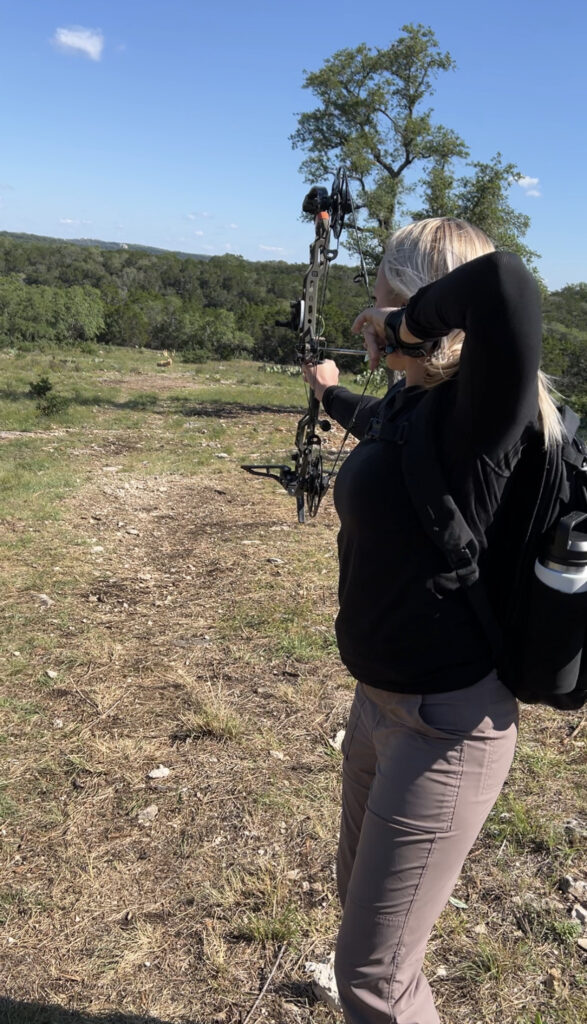
In the picture below, I am setting up for a long archery shot. You can see the importance of rear delts in the ability to draw the bow and hold while I aim.

rear delt exercises for archery performance
Rear delt strength is important in archery.

Balanced Physique

Finally, rear delt exercises can help create a balanced physique. Many people focus on the front of their bodies, neglecting the back. By including rear delt exercises in your workout routine, you can help create a balanced physique and avoid muscle imbalances.

Equipment Needed for Rear Delt Exercises

Rear delt exercises are important to do well and not haphazardly. Because of this, you won’t be piling on the weight or trying to go heavier heavier, every day. For this reason, you can use no equipment, light dumbbells, and cable and resistance bands. 

Rear Delt Exercises with Resistance Bands

Resistance bands are a versatile and affordable option for rear delt exercises. They come in many resistance levels and can be used for a variety of exercises, including face pulls and reverse flyes. Resistance bands are also portable, making them a great option for those who want to exercise at home or on the go. Take those babies on that vacation and get some rear delt work in on the beach or in the hotel!

Rear Delt Exercises Dumbbells

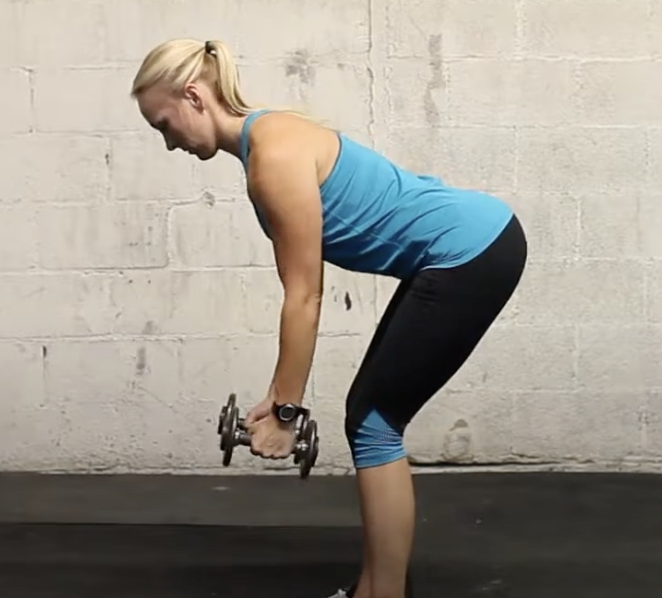
Dumbbells are another popular option for rear delt exercises. They allow for a greater range of motion and can be used for a variety of exercises, including bent-over lateral raises and reverse flyes. Dumbbells obviously come in various weights, making them a great option for all fitness levels.

best rear delt exercises
a bent over raise, a rear delt exercise with dumbbells

Cable Machines for Rear Delt Work

Cable machines are usually big and expensive, so they are more often in public gyms than home or garage gyms. Cables allow for a wide range of exercises, including face pulls and cable reverse flyes. They provide constant resistance throughout the movement, making them an effective option for targeting the rear delts.

Ancore Training System

The Ancore training system is a home cable system that is lightweight, portable, and costs a fraction of the cost of a weight plate cable system. I honestly can’t even explain how the Ancore works, but I know it works.

I have one, and I love it so much. I attach my Ancore to my squat rack, but they can be wall mounted, or mounted to anything you can get creative with. It’s a great option for pulling exercises, including rear delt exercises.

Ancore training system in my garage gym

Rear Delt Fly Machine

The rear delt fly machine is a specialized piece of equipment designed specifically for targeting the rear delts. It provides a controlled movement and allows for a greater range of motion than other equipment. There are a few variations of these. They are less common in gyms because they take up a big footprint for a very small precise movement. If you can find them, however, I encourage you to try them. 

Overall, there are a variety of equipment options available for rear delt exercises. It is important to choose equipment that is suitable for your fitness level and goals.

Best Rear Delt Exercises

Here are a few exercises to put into your routine to incorporate rear delts.

All of the following videos are of me demonstrating, and posted on my YouTube channel.

Dumbbell Rear Delt Fly

The dumbbell rear delt fly is a classic exercise that targets the rear delts, upper back, and traps. To perform this exercise: 

  • stand with your feet shoulder-width apart, holding a pair of dumbbells at arm’s length in front of your thighs
  • bend your knees slightly and hinge forward at the hips, keeping your back flat like a tabletop and your core engaged
  • lift the dumbbells out to the sides, squeezing your shoulder blades together at the top of the movement
  • lower the weights back down to the starting position and repeat for as many reps as you’d like

Seated Rear Delt Machine

The seated rear delt machine is a great option for those who prefer using machines over free weights. To perform this exercise: 

  • sit at the machine with your chest against the pad and your arms extended out in front of you
  • grasp the handles and pull them back towards your chest, squeezing your shoulder blades together at the top of the movement
  • in a controlled manner, return the handles back to the starting position and repeat for your desired number of reps

Bent Over Reverse Fly (Rear Delt Raise)

The bent over reverse fly, or rear delt raise, targets the rear delts and upper back. To perform this exercise:

  • stand with your feet shoulder-width apart, holding a pair of dumbbells at arm’s length in front of your thighs
  • bend your knees slightly and hinge forward at the hips, keeping your back flat and your core engaged
  • lift the dumbbells out to the sides, keeping your elbows slightly bent and squeezing your shoulder blades together at the top of the movement
  • lower the weights back down to the starting position and repeat for as many reps as you’d like

Bent Over Rear Delt Row

The bent over rear delt row is very similar to the bent over reverse fly, except you’ll bend at the elbow, like you are a puppet. Your elbow will extend toward the ceiling, but not your forearm. To perform the rear delt row:

  • stand with your feet shoulder-width apart, holding a pair of dumbbells at arm’s length in front of your thighs
  • bend your knees slightly and hinge forward at the hips, keeping your back flat and your core engaged
  • lift the dumbbells out to the sides, with your palms facing behind you
  • Bend at the elbows and squeeze your shoulder blades together at the top of the movement
  • lower the weights back down to the starting position and repeat for as many reps as you’d like

Reverse Pec Deck Fly

The reverse pec deck fly is a machine-based exercise that targets the rear delts and upper back. To perform this exercise:

  • sit at the machine with your chest against the pad and your arms extended out to the sides
  • grasp the handles and squeeze your shoulder blades together as you bring your arms back towards your chest
  • slowly return the rope back to the starting position and repeat for your desired number of reps

Y

The Y is a fantastic exercise that can be done with or without weight. If you do use weight, use a very light weight, like 1-3 pounds to begin. You can do this by holding a hinge position yourself, or using a bench to stabilize you. To perform the Y:

  • hinge at the hips with back neutral and straight
  • extend arms with palms facing behind you
  • bend at the elbows as if you are elbowing the ceiling
  • rotate your arms up into a “touchdown” position
  • extend your arms into a “Y shape
  • bend at the elbows, rotate arms, and straight elbows to return to the start position

Face Pull

Face pulls are an excellent exercise for targeting the rear delts, upper back, and rotator cuff muscles. These instructions are for a cable face pull, but you can do this with a securely fastened band too. To perform face pulls:

  • with arms extended, step away from the cable so there is constant tension (the plates aren’t resting on the weight stack)
  • stand in a secure stance. I prefer staggered feet
  • stand with your shoulders over your hips and not leaning way backwards
  • with elbows out to your sides, bend at the elbows to pull your hands toward your face
  • think about squeezing the back of your shoulders
  • extend your shoulders to your start position and repeat for as many reps as you’d like

Band Pullaparts

Band pullaparts are a great rear delt exercise that you can do anywhere with a band. These are so good for optimal posture. To perform this exercise: 

  • stand tall
  • extend your arms in front of you, gripping a light band
  • keep elbows straight but not locked as you press your arms straight around your side
  • I prefer palms down but you can experiment with different hand positions
  • squeeze your shoulders behind you as you make a big wide sweep with your arms
  • press until the band touches your chest
  • control the return to your start position and repeat

Example Rear Delt and Shoulder Workout

Here is a sample shoulder session that includes all angles of the shoulder: 

A1. standing dumbbell overhead press, 3×10, as a warm up

A2. Y, 2×10

B. barbell press, 5×8, progressively heavier. Rest in between!

C1. bent over rear delt raise, 4×10

C2. band pullaparts, 4×10

D1. facepull, 3×15

D2. bent over rear delt row, 3×15

Safety Tips for Rear Delt Exercises

When performing rear delt exercises, it is important to keep safety in mind to avoid injury. Shoulders aren’t delicate, but you want to be smart when working them. Here are some safety tips to keep in mind:

  • Always warm up properly before beginning any exercise routine. This will increase blood flow to the muscles and prevent injury. It also helps performance.
  • Start with lighter weights and gradually increase the weight as your strength improves.
  • Keep your movements slow and controlled. Jerky or fast movements can put unnecessary strain on your muscles and increase the risk of injury.
  • Use good form when performing exercises. Sloppy form can put unnecessary strain on your muscles and increase the risk of injury. If you are unsure of the proper form, seek guidance from a certified personal trainer. Or ask me!
  • Listen to your body. If you experience pain or discomfort during an exercise, stop immediately and consult with a doctor or physical therapist.

By following these safety tips, you can help to prevent injury and get the most out of your rear delt exercises.

Common Mistakes While Doing Rear Delt Exercises

When performing rear delt exercises, it’s important to ensure proper form to avoid injury and maximize results. Here are some common mistakes to avoid:

Using Too Much Weight

One of the most common mistakes people make when doing rear delt exercises is using weights that are too heavy. This can put unnecessary strain on the shoulders and lead to injury. Choose a weight that you can do well with good form.

Poor Posture

Another mistake people make is having poor posture during rear delt exercises. This can put additional strain on the neck and upper back, leading to discomfort and pain. It’s important to maintain proper posture throughout the exercise, keeping the chest up and shoulders back.

Not Isolating the Rear Delts

Many people make the mistake of not isolating the rear deltoids during exercises. Instead, they end up using their traps and other muscles to compensate. To properly target the rear delts, it’s important to focus on squeezing the shoulder blades together and keeping the elbows slightly bent.

Neglecting the Warm-Up

Lastly, some people neglect to include a proper warm-up when doing rear delt exercises. This can increase the risk of injury and decreased performance. It’s important to perform a few warm-up exercises before starting and to stretch the muscles afterwards to prevent injury and promote recovery.

By avoiding these common mistakes, you can ensure that you’re getting the most out of your rear delt exercises and avoid any unnecessary injuries or discomfort.

Progress Tracking for Rear Delt Exercises

Tracking progress is important any time you are training. This is easy to do when we are talking about powerlifting, or increasing the weights on specific exercises such as the squat or deadlift. Rear delt progress can be a bit harder to see, so here are some ways to track the progress of rear delt exercises:

  • Increasing reps as you increase your muscle endurance
  • Increasing the weight when you can do 10+ with impeccable form
  • Measurements
  • Fit of your clothing. If you don’t want to measure, just notice that your shirts, dresses and coats might be a bit snugger around your shoulders. Yay! This is good! 

Train Your Rear Delts to See For Yourself

Overall, understanding the importance of rear delt work can make your training and your strength much better. Find and practice the best rear delt exercises to see this progress for yourself! If you have questions, remember you can always email me, or contact me about working together.

Best of luck with your training!

Related Reading:

Best exercise machines for lower back strength

Best Dumbbell Back Exercises


About the author

Kathryn Alexander is a strength coach and personal trainer in Austin, Texas. She loves hiking, college football, and the feel of a perfectly knurled barbell. Read more about Kathryn here.

  • 5 steps to keep fitness progress
    5 Steps To Keep Progressing On Your Fitness Right Now
  • Thanksgiving friends at Big Tex Gym
    Thanksgiving Joy + Fitness Momentum (Yes, Both!)
  • Austin personal trainer Kathryn Alexander shares her clients' secret for successful holidays.
    My Clients’ Secret for Successful Holidays
  • Gifts for powerlifters: wrist wraps
    The Best Gifts for Powerlifters and What 1 Gift to Avoid
  • More Semi-Private Personal Training Options!
  • Quick Note: Exercise is Quality of Life

Filed Under: Training

Push Pull Squat Workout

August 14, 2023 by Kathryn Alexander

The push pull squat workout is a great framework for getting a complete training session. Generally I’d like you to be on a program that is well planned out, instead of randomly throwing workouts together. Following a program ensures you are getting a comprehensive training experience with no holes or gaps. 

A good program will hit on all aspects of pushes, pulls and squats, and this framework can even be applied to the random one-off workouts you do outside of a program. 

Sometimes life makes it hard to follow a program and you just have to get a workout. Maybe you are out of town, on vacation or for whatever reason, away from the equipment that you need. In this case, whip out the push pull squat to create a solid workout.

push pull squat workout

Why Push Pull Squat

One time in college, a gym friend of mine told me he had the perfect training split. I couldn’t wait to hear! We were gym nerds, going through that phase where we obsessed about finding the perfect split, the best new way to workout, etc.

“Ok, tell me!” I asked, excited about this mind-blowing new plan.

He said, “It’s chest on Monday, back & bi’s on Tuesday, shoulders and triceps on Wednesday, abs on Thursday, and chest and bi’s again on Friday!” He was giddy with excitement. 

“But what about legs?!” I asked him. It was the ultimate 20 year old boy program, with a huge gap in there where legs should be. Can you imagine not training half your body?? That’s a whole ‘nother blog post though!

He was hitting the upper body push and pull well, but skipping the entire squat.

How to Plan Your Training Split

There are several ways to plan a training program. How you decide what exercises to do in what day/training session is called a training split, by the way. A few of the common ways are by:

  • Body parts, like my friend described above
  • Anatomical location, such as anterior day, posterior day
  • Planes of movement, such as upper body push, upper body pull, etc.

I think of push pull squat as planes of movement. In my mind, a classic push is the bench press or pushup. Dumbbell presses are a great example too. The pull is a barbell or dumbbell row.
However, those examples are just in the horizontal plane of motion. A pull is also a pull-up or a lat pulldown. A push is also a dumbbell overhead press or military press.

A squat is always a good choice, so taken literally, so squats for push pull squat. You could also do a lunge, any variation. You could even deadlift, which is typically considered a lower body pull. However, the point is to get a compound lower body exercise so the deadlift works great. 

I wrote a whole blog post about training splits and which is best for you, including how many days a week to train. If you are interested in that, read here: all the details on training splits.

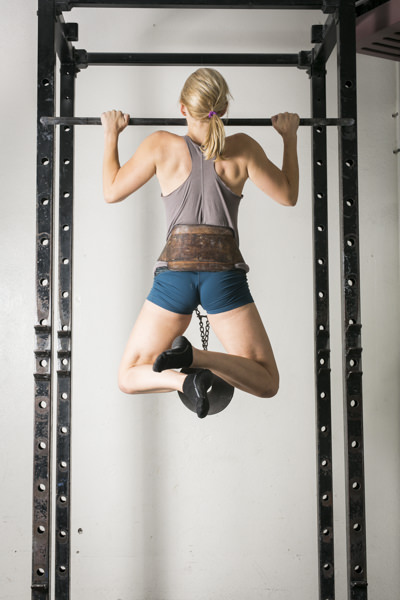
pullups in push pull squat workout

Examples of Push Pull Squat Workout

If you are doing a one-off workout, I would suggest picking a push, a pull, a squat, and making those your whole workout. For example, I love bench press, pull-ups, and squats, so I would do all of those to make one complete session. It would look like this: 

Warm up: light goblet squat superset with standing dumbbell press

  • Squats: warm up sets of about 5 reps, then 3 sets of 5 with 2 reps in reserve
  • Bench press: same as squats. Light warm ups, then 3 x 5
  • Pullups: 3 sets of as many as I can

Example of push pull squat with just one dumbbell: 

  • Walking lunges, 4 x 10
  • Pushups, 4 x 10
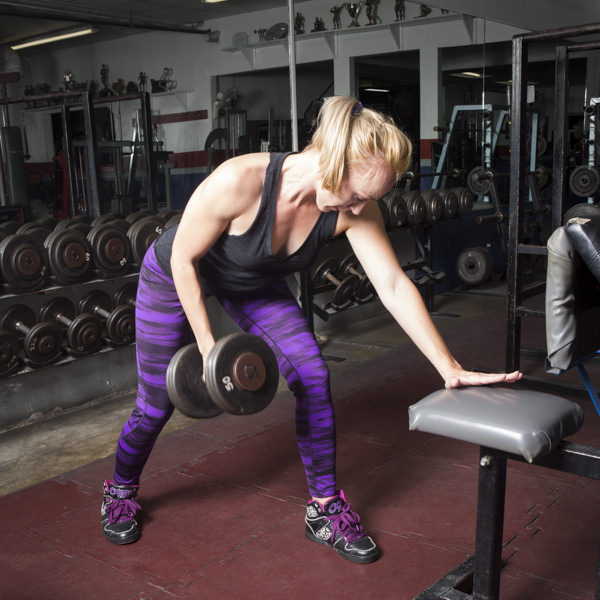
  • 1 arm dumbbell row, 4 x 10

Another example, in a full gym: 

  • Lat pulldowns, 4 x 12
  • Seated dumbbell shoulder press, 4×12
  • Front squat, 4×5

How to Implement Push Pull Squat

If you’d like to build out a whole program using the push pull squat method, a great way to do this is to build 3 full body sessions per week. These will look similar to the above examples, but will complement each other. An example of this is: 

Push Pull Squat 3 days a week

Monday

  • Military press
  • Back squat
  • Lat pulldowns or pull-ups

Wednesday

  • Bench press
  • Front squat
  • 1 arm dumbbell row

Friday

  • Dumbbell bench press
  • Lunge or deadlift
  • Pullover
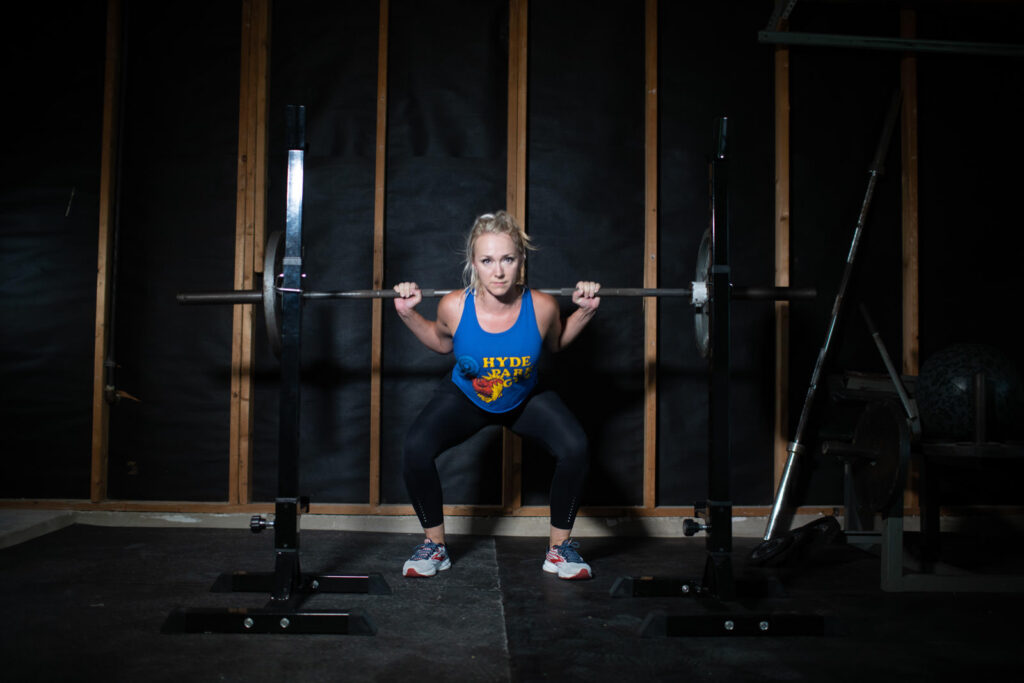
squats by Kathryn Alexander, personal trainer Austin

Another way to implement push pull squat into a program is to have a dedicated push day, a dedicated pull day, and a dedicated squat day. This is a bit more of a bodybuilder style program, instead of the full body athleticism of the prior program. An example of this week is: 

Push Pull Squat Workout, each on dedicated day

Squat

  • Back squat
  • Walking lunges or BSS
  • Any leg accessories such as leg press, extensions or curls
  • I like to finish a session like this with reverse hyperextensions or back extensions, even though they don’t fit the criteria of “squat”

Push

  • Bench press
  • Seated dumbbell shoulder press
  • Lateral raise
  • Skullcrushers
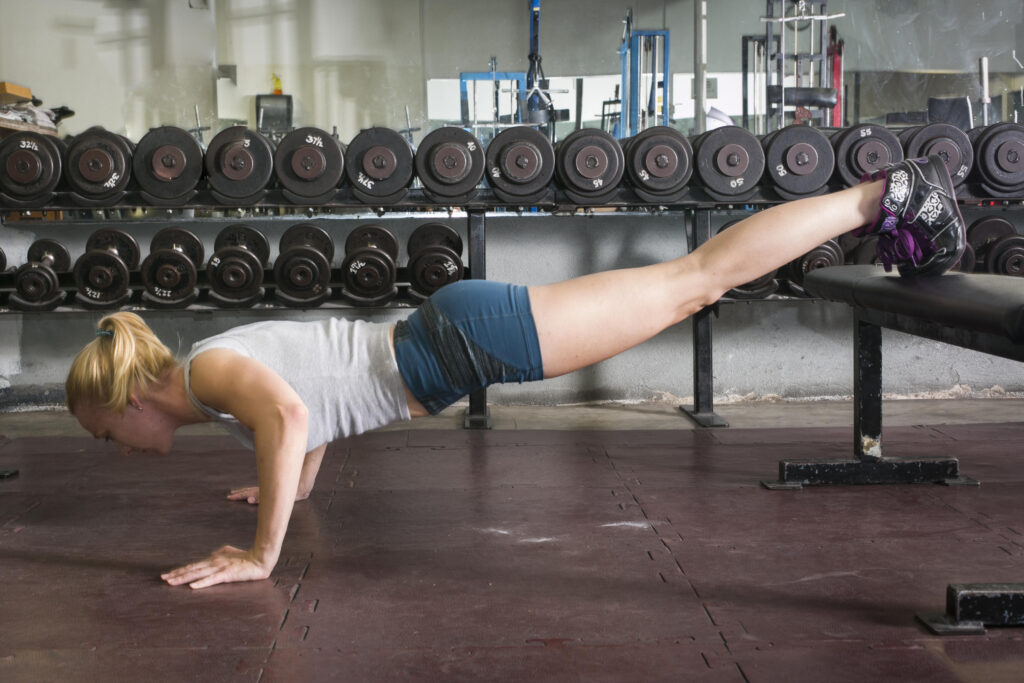
  • Pushups finisher

Pull

  • Lat pulldowns
  • Pullups
  • 1 arm dumbbell row
  • Biceps curls
  • Pullover
pushups for push pull squat workout

Your Turn!

How will you implement these in your training? I love hearing how people plan their training! Let me know! Also let me know if you have questions. Message me or comment – I have time for you! Happy training 🙂


About the author

Kathryn Alexander is a strength coach and personal trainer in Austin, Texas. She loves hiking, college football, and the feel of a perfectly knurled barbell. Read more about Kathryn here.
Filed Under: Training

How to do Standing Calf Raise + Modifications

August 10, 2023 by Kathryn Alexander

The standing calf raise is an easy, versatile exercise that can be done anywhere. You can use a standing calf raise machine at a gym, which allows you to load weight on your calves. You can also do this from anywhere with no weight. Even if this doesn’t feel challenging for you, it’s a great exercise that can build your calves. 

I’ll show you a variation of the unweighted standing calf raise that allows for a bit more challenge on your calves. I first learned these from Nick Tumminello. 

Why Should I Do Calf Raises? 

Calf raises are beneficial for many reasons. Calf raises work the two primary muscles that you think of when you think of calves: gastrocnemius and soleus. Together, these muscles assist with any kind of bipedal locomotion: walking, running, skipping. Basically, anything athletic or movement based. 

Strengthening your calves through a full range of motion also improves ankle mobility and strength. 

Standing calf raise machine

How to do the Standing Calf Raise

  • Stand flat on the ground, feet about shoulder width. Optionally, you can stand with your toes 1 or more inches higher than your heels for greater range of motion. 
  • Let your weight sink into your heels if toes are elevated. 
  • Keep your knees slightly bend and legs NOT locked out
  • Push the balls of your feet into the ground.
  • Squeeze your calves as you raise your heels as high as you can. 
  • Return to your start position in a controlled manner; don’t just drop your heels back down. 
  • Repeat for as many reps as you are aiming for

How to Modify The Calf Raise for Greater Challenge

If you don’t have a calf raise machine, then to challenge yourself, we’re simply going to add more range of motion here. To do this, take a step back from a wall and then lean into it. The starting position of your heel will be lower, but the rest of the movement mechanics will be similar. This is called the leaning calf raise.

Related: these often overlooked exercises are some of the best exercises for rear delts

Control through the whole movement (up and down), and squeeze your calves at the top. 

Should I Add Weight to My Calf Raises? 

You can add weight if you’d like to increase the challenge of your calf raises, but this is not always necessary. You will still get some benefits without a big machine or heavy barbell. 

Start with 3 sets of about 20, with no weight. If you haven’t been doing any direct calf work, I’d recommend doing this 2-3 times a week for a couple weeks. From there, you can hold a weight if you’d like. You can add more reps and sets as well. Be sure to give yourself an easy couple of weeks first, though. 

In a study of 26 untrained young men, groups did either heavier weight (lower rep) or lower weight (higher rep) calf work. Both groups shows statistically significant increase in the calf muscles. Full study by Brad Schoenfeld and Bret Contreras here.

Yes, they were untrained to begin, so it stands to reason they would see progress, but this is really heartening, especially to those who work out at home without tons of equipment. So – get to your calf work! Increase your calf strength, balance, ankle mobility and all from home. 

Please message me if you have questions, or need a plan for your fitness! 

standing calf raise by Austin personal trainer Kathryn Alexander

References:

Brad Schoenfeld, Bret Contreras, et al., “Do the anatomical and physiological properties of muscle determine its adaptive response to different loading protocols?” Physiology Reports, 27 April 2020.


About the author

Kathryn Alexander is a strength coach and personal trainer in Austin, Texas. She loves hiking, college football, and the feel of a perfectly knurled barbell. Read more about Kathryn here.

  • 5 steps to keep fitness progress
    5 Steps To Keep Progressing On Your Fitness Right Now
  • Thanksgiving friends at Big Tex Gym
    Thanksgiving Joy + Fitness Momentum (Yes, Both!)
  • Austin personal trainer Kathryn Alexander shares her clients' secret for successful holidays.
    My Clients’ Secret for Successful Holidays
  • Gifts for powerlifters: wrist wraps
    The Best Gifts for Powerlifters and What 1 Gift to Avoid
  • More Semi-Private Personal Training Options!
  • Quick Note: Exercise is Quality of Life

Filed Under: How To Tagged With: how to

From UT Student to Personal Trainer

August 8, 2023 by Kathryn Alexander

I recently wrote a guest article for Austin Fit Magazine, about how to go from a student at The University of Texas at Austin to becoming a personal trainer.

This is an article that is near and dear to my heart, because UT is my graduate alma mater, and I am now a personal trainer in Austin, Texas.

Degree Paths to Becoming a Personal Trainer

In this article, I share details about which degree to choose and how else to best prepare yourself, with work experience and continuing education, to give yourself (and your future clients!) the best chance of success.

If you aren’t on this degree path, this might be a dry read for you. Sorry. 🙂 But if you ARE on this path and I can help, please reach out to me!

Read the whole article here

  • The Best Gifts for Powerlifters and What 1 Gift to Avoid

    The Best Gifts for Powerlifters and What 1 Gift to Avoid

  • 5 Steps To Keep Progressing On Your Fitness Right Now

    5 Steps To Keep Progressing On Your Fitness Right Now

  • Thanksgiving Joy + Fitness Momentum (Yes, Both!)

    Thanksgiving Joy + Fitness Momentum (Yes, Both!)

  • My Clients’ Secret for Successful Holidays

    My Clients’ Secret for Successful Holidays


About the author

Kathryn Alexander is a strength coach and personal trainer in Austin, Texas. She loves hiking, college football, and the feel of a perfectly knurled barbell. Read more about Kathryn here.
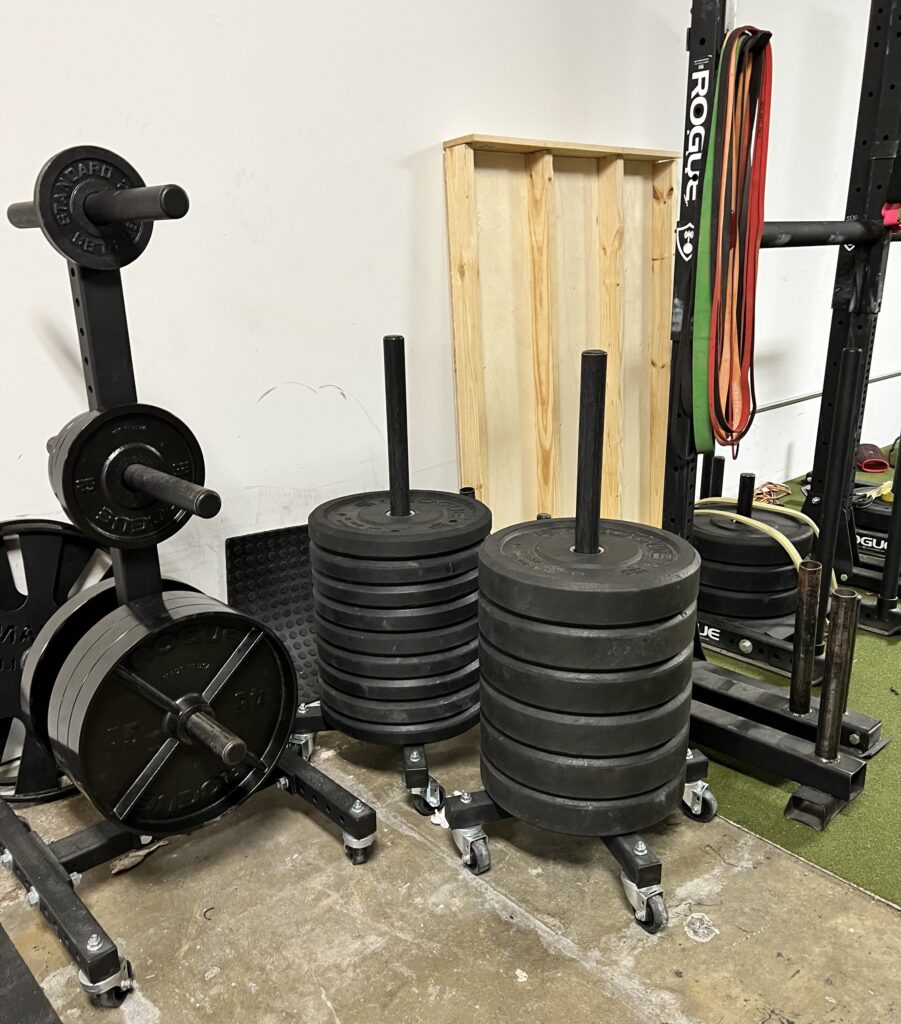
Filed Under: Misc.

Dua Lipa, Michael B. Jordan Workout: How They Got Fit

August 7, 2023 by Kathryn Alexander

Dua Lipa and Michael B. Jordan workout, like many other actors and actresses, to stay and get fit for their roles.

From her high intensity interval work, to Michael B. Jordan’s shorter training sessions, here are some snippets from articles I have contributed to lately.

Note: I do not know either of these celebrities or their trainers; I was consulted for expert commentary on their workout routines.

Michael B. Jordan Workout

Michael B. Jordan has a habit of staying fit, especially as many of his acting roles necessitate a strong and healthy character. If you’ve seen his performance in Creed III, you can see he took no shortcuts in his training.

In addition to eating healthy protein and fruits, he is said to employ quick training sessions as his schedule gets busy. Here’s what I think of that:

Here is the rest of the article about Michael B. Jordan’s workout routine, and his methods for eating well, building muscle and staying lean with a busy schedule. It includes his stories about workouts and preparing for roles, and many other experts insight.

Dua Lipa is Fit and Stunning for Barbie Premiere

Dua Lipa dazzled as a mermaid in the Barbie movie. One thing she reportedly did was high intensity interval training. I love this; it’s a great training method. Of course, HIIT isn’t the only way to do cardio but it’s a great option. As you can see, she looks fantastic – it’s clearly working for her!

Check out the rest of the article for the full story: Dua Lipa Stuns at Barbie Premiere. Here’s How She Gets Fit.

Here’s a quick push pull squat workout you can do at home. You can make this high intensity, as well.


About the author

Kathryn Alexander is a strength coach and personal trainer in Austin, Texas. She loves hiking, college football, and the feel of a perfectly knurled barbell. Read more about Kathryn here.
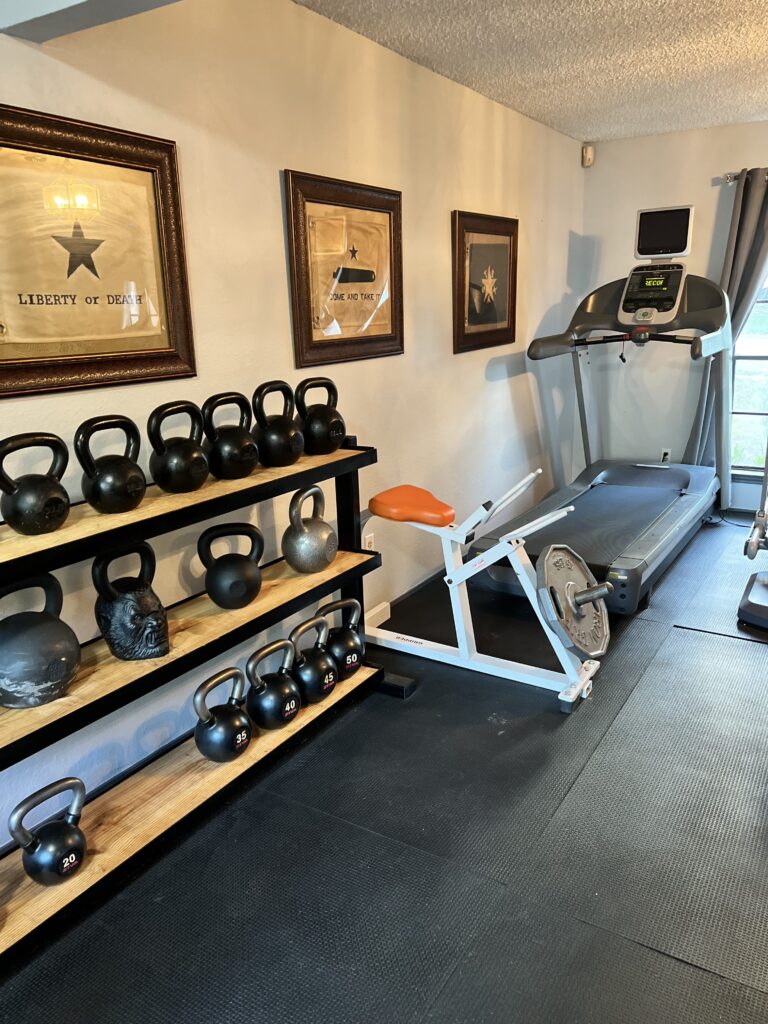

  • 5 steps to keep fitness progress
    5 Steps To Keep Progressing On Your Fitness Right Now
  • Thanksgiving friends at Big Tex Gym
    Thanksgiving Joy + Fitness Momentum (Yes, Both!)
  • Austin personal trainer Kathryn Alexander shares her clients' secret for successful holidays.
    My Clients’ Secret for Successful Holidays
  • Gifts for powerlifters: wrist wraps
    The Best Gifts for Powerlifters and What 1 Gift to Avoid
  • More Semi-Private Personal Training Options!
  • Quick Note: Exercise is Quality of Life

Filed Under: Misc. Tagged With: real people

Curling in the Squat Rack

August 2, 2023 by Kathryn Alexander

If you’ve hung around gyms enough, you’ve heard, “No curling in the squat rack!” Is this really true? Will you immediately be kicked out, membership revoked, and publicly shamed, if you curl in the squat rack?

The short answer is, haha maybe! Yes, curling in the squat rack is frowned upon. Here’s why.

If you’re reading this in January, happy new year! Check out this guide on how to make and keep new year fitness resolutions.

Why Squat Racks Are In Demand

Ah, the squat rack! The most fun, or the most intimidating piece of equipment in any gym. It’ll separate the men from the boys, put hair on your chest… or whatever silly phrase you want to use. It is often misunderstood, feared, or blamed for all kinds of aches and pains. 

The truth is, the squat is one of the most useful and important lifts for everyone, male or female, young or old. 

curling in the squat rack
This is an old screen grab, hence the quality. Anyhow, I have a spotter here, so I’ll be safe, but you can see how this is a risky lift to do outside of the squat rack. I had a planned max squat that day, and that should come before curls.

Because of this, you’ll often see squat racks fully booked in gyms whose culture supports lifting. Lifters often spend more time on the squat rack than at other gym locations, because the squat requires a smart and deliberate warm up. It takes longer than other exercises, both to warm up, and to rest between sets. 

Additionally, the squat rack is the only safe place to actually squat heavy. Because of this, squat racks are often in use. 

Squat Rack Etiquette

It becomes problematic when people take an entire squat rack to curl, which is an exercise that can be performed in pretty much any other location in the gym. There are usually dedicated straight bars already fixed with weights. There are dumbbells for hammer curls, concentration curls, preacher curl machines, and cables for more curls. 

There are seated racks for shoulder pressing, and dumbbells for overhead pressing. There are shoulder press machines. Sure, these exercises can be a bit easier in the squat rack, and yeah, it’s fun to use the big barbell! 

Squat in the Squat Rack

BUT- hold your horses, there! As mentioned previously, there’s nowhere else in the gym to safely squat, but a squat rack. Because of this, squatters should have priority in the squat racks.

The caveat is if the gym is slow and there are many racks available. In that case, it may be ok to use it for a few sets of presses or curls. Sometimes, the squat rack is a great place to modify an exercise for a client, such as for doing pushups from an elevated bar. In this case, the squat rack is extremely convenient. 

However, squatters should again be given priority for this specific lift. It’s just a courteous thing to do.

More about dumbbell curls: muscles worked, what exercises to do, and more to get bigger and stronger arms.

How to Share a Squat Rack

If pressing or curling in the squat rack is important to you, consider going to the gym at off times when it is less busy. You might find you have time to get your training in without dirty looks from busy exercisers. 

Consider the rest of the gym, and all the other dedicated areas to work specific movements. Be creative! Watch home gym exercisers. With a small home gym or garage gym, they figure out workarounds for everything!

Finally, if you do use the squat rack for something other than it’s intended purpose, just be courteous. If you’re a regular, you’ll know when people need the racks and when they are waiting. If someone is waiting, you can let begin working in while you finish your sets. Here’s a great goblet squat tutorial. Goblet squats can be used as a warm up while you are waiting to squat, or an accessory to get more volume after.

You can also use this time to work some of the best rear delt exercises, which are often overlooked but always valuable.

Start Here

If you’re brand new to the gym and want to learn more of the etiquette as you do your exercise, try my program Square 1. This is meant to teach the brand new exerciser how to get a workout, and how to navigate a new gym. Also read How to Overcome Gym Intimidation. You really do belong in the gym!

Please feel free to contact me if you have any questions or would like to do a free consult. Happy training!


About the author

Kathryn Alexander is a strength coach and personal trainer in Austin, Texas. She loves hiking, college football, and the feel of a perfectly knurled barbell. Read more about Kathryn here.
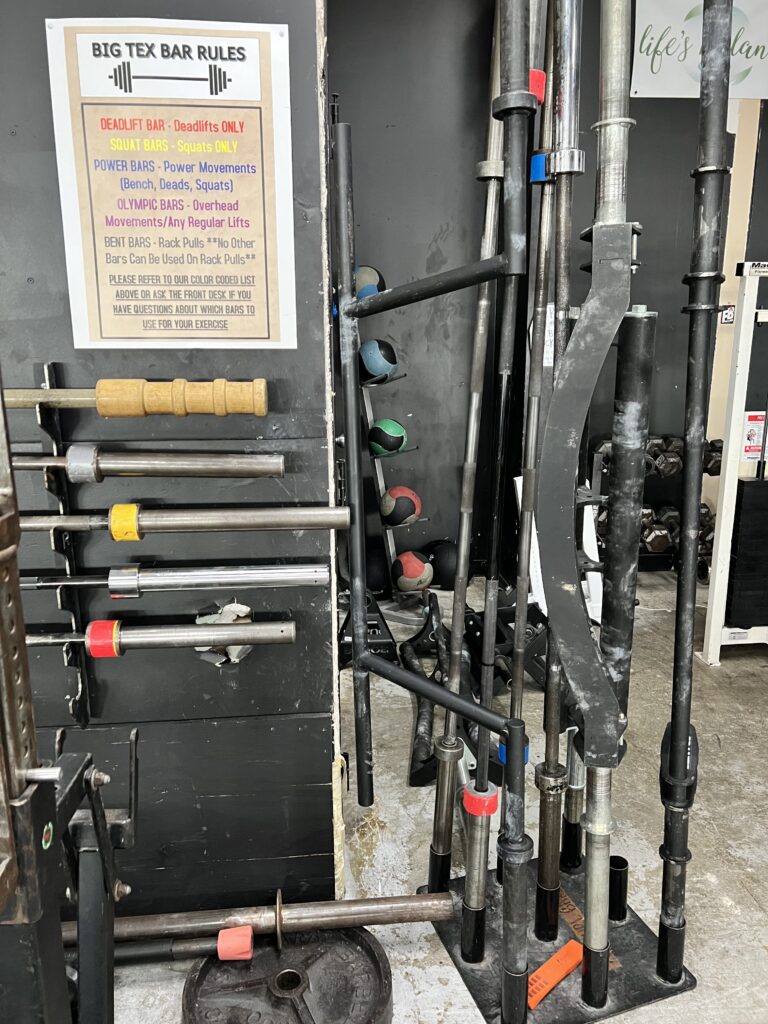

  • 5 steps to keep fitness progress
    5 Steps To Keep Progressing On Your Fitness Right Now
  • Thanksgiving friends at Big Tex Gym
    Thanksgiving Joy + Fitness Momentum (Yes, Both!)
  • Austin personal trainer Kathryn Alexander shares her clients' secret for successful holidays.
    My Clients’ Secret for Successful Holidays
  • Gifts for powerlifters: wrist wraps
    The Best Gifts for Powerlifters and What 1 Gift to Avoid
  • More Semi-Private Personal Training Options!
  • Quick Note: Exercise is Quality of Life

Filed Under: Misc.

How Much Does a Personal Trainer Cost?

August 1, 2023 by Kathryn Alexander

Working with a good personal trainer can be on of the greatest investments you ever make. If you find a highly educated and experienced personal trainer, your trainer can help you find the best path for your health that will maximize your time spent exercising and minimize your change of injury. So how much does a personal trainer cost? Read on to find out what to pay and how to work with a trainer. 

Average Personal Trainer Cost

The short answer to this is, it depends where you live and what your market is like, how involved you want your trainer to be, and what kind of facility you are working together at. 

The Personal Trainer Development Center estimates the average cost at $60-70 per hour long training session.

This will very wildly depending on where you are paying for training services. 

When you are considering whether this is worth it, think about the price you’d pay for a massage. It’s probably similar. Unlike your massage therapist, your trainer will usually make you a whole workout program, follow up with you, and continue to be invested in your progress. It’s not a one-time situation.

how much does a personal trainer cost

How Much Does a Personal Trainer in Austin Cost?

The average cost of a personal trainer in Austin seems to be about $100. You can find less and you can find a much more expensive but expect to pay somewhere around $100. You might also have to pay a gym membership but hopefully you will be going to the gym enough to justify that.  

This number will also vary based on where you go. Again, big box gyms will have newer trainers who are taught how to sell, and you can usually find trainers on the lower end of the price range there. Self-employed trainers tend to run a bit higher.

Why Does it Cost So Much to Work With a Personal Trainer?

You might not know that there is no legal requirement in the US to be a personal trainer. Anybody can just say that here she is a trainer and start charging for it. It’s up to you to do your due diligence and make sure your trainer is educated. Of course everybody starts somewhere, but I do recommend getting a trainer with a few years experience. I would also find a trainer who has worked with people like you, who have goals like yours. 

Hopefully your trainer has a degree in kinesiology or exercise science. You at least want them to have taken anatomy and physiology. If they have put years into their career, the coursework and continuing education units are very expensive. They’ve also experimented on their own bodies, and done their own workouts, and put in their own effort and sweat. 

I also highly suggest finding a self-employed trainer. Find a trainer who contracts out of a gym and is not employed at a large box gym. The exception is if a local gym hires great trainers. Most often, big gyms, like Lifetime Fitness, and Gold’s, just hire anybody and teach them how to sell. 

Bonus points if your trainer is a total equipment nut and loves everything about the inner workings of barbells, dumbbells, and the best machines available to you.

You don’t want that. Find someone who is proven that he or she can make it as a trainer on their own merits. In this case, the trainer is probably paying at least $500+ per month to the gym they work at. 

Many trainers will buy their own equipment as well, especially those who travel to clients. 

Finally, many trainers like myself who take this profession seriously also pay monthly for training software to deliver you the best workouts. We put hours in behind the scenes doing follow up planning for you. I pay for scheduling and billing software as well, to make it easier for you to make your appointments fit your schedule.

All of this plus self-employment fees goes into your trainers fee.

Other Ways to Work With a Personal Trainer

If this all seems cost prohibitive, contact the trainer you’d like to work with. Often, trainers have pairs prices, small group classes, or training programs that are at a lesser cost. In my case, I match make clients who would like to work together to reduce cost. I don’t put new people with someone immediately, because I’d like to make sure to get to know a person and his or her goals first. 

I also have training programs which are about $15 – 35 a month. These are my plans that I make and maintain, and you can contact me at any point. 

Trainers also make sure there aren’t gaps in your programs, and they help you add in exercises you might never even think to do, such as rear delts. They ensure you are doing a well rounded program that will get you to your results in the best way possible.

About half my clients who work with me have worked with me for years. The other half of my clients work with me for 1-3 months and then continue on their own. Most keep up with me and we are still making sure they are comfortable with their plan and progress! 

This is an option as well, to budget for a trainer to teach you how to do it on their own. Most trainers are absolutely ok with this, and would love to help you learn how to do your own program. 

Don’t be scared to reach out! The worst a trainer can say is that your plan doesn’t fit their business model. If so, that’s ok. They might have referrals. If not, go back to google. 

Good Luck With Your Training!

I wish you the best of luck in finding your personal trainer! Here is a more in depth look at how to find a personal trainer and all of your personal training options. Let me know if I can help you at all! 


About the author

Kathryn Alexander is a strength coach and personal trainer in Austin, Texas. She loves hiking, college football, and the feel of a perfectly knurled barbell. Read more about Kathryn here.
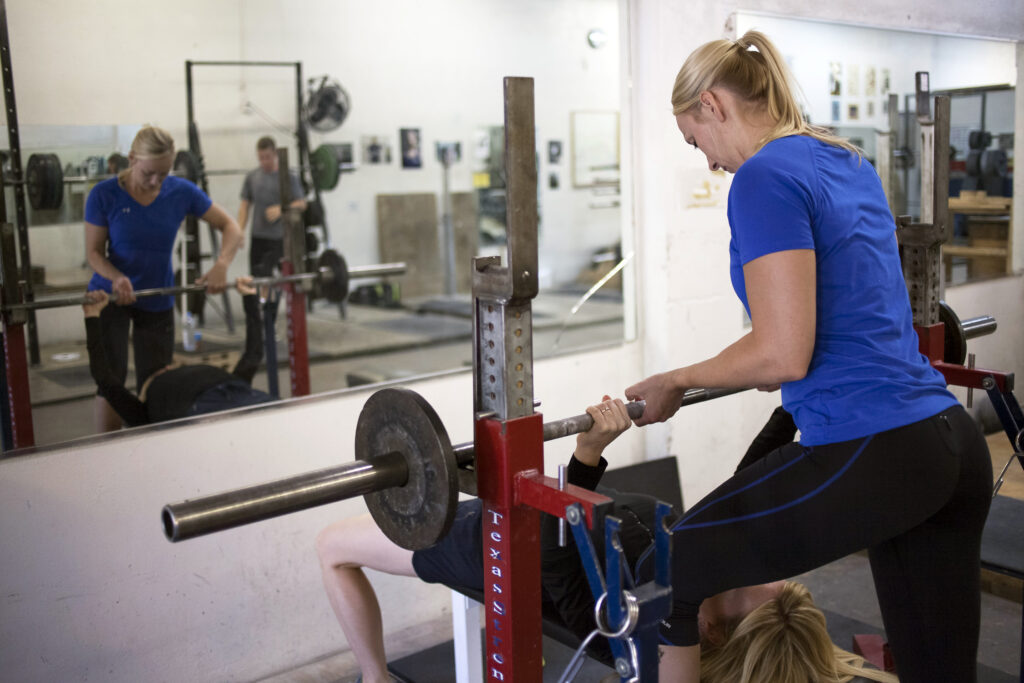

  • 5 steps to keep fitness progress
    5 Steps To Keep Progressing On Your Fitness Right Now
  • Thanksgiving friends at Big Tex Gym
    Thanksgiving Joy + Fitness Momentum (Yes, Both!)
  • Austin personal trainer Kathryn Alexander shares her clients' secret for successful holidays.
    My Clients’ Secret for Successful Holidays
  • Gifts for powerlifters: wrist wraps
    The Best Gifts for Powerlifters and What 1 Gift to Avoid
  • More Semi-Private Personal Training Options!
  • Quick Note: Exercise is Quality of Life

Filed Under: Personal Training Tagged With: personal training

How to do the Back Extension Machine

July 31, 2023 by Kathryn Alexander

The back extension movement is a very important piece of your posterior development. Learn how to do the back extension machine to make your back, glutes and hamstrings strong and effective. 

back extension machine demonstrated by Kathryn Alexander, personal trainer in Austin, Texas.
This is the back extension machine at Big Tex Gym in Austin, Texas. Demonstrated by Austin personal trainer Kathryn Alexander.

What is Back Extension?

Extension of the hip (also called back extension) works back, glutes and hamstrings. The back extension machine targets this, unlike other back exercises, which work mid or upper back. Examples of these are pull ups and rows. 

The back extension machine is a fantastic complement to any powerlifting style program. In fact, I think it’s valuable for everybody. You do not have to do this heavy to get benefits, but you can load it if you’d like. To do this, hold a weight plate, barbell, or use bands. 

Overall, the back extension is just a great exercise that can help strengthen the lower back and prevent low back pain. 

This is a 45 degree back extension machine, which is fairly common in many gyms.

How to Set Up For the Back Extension

The most important part of the set up for the back extension is to be sure that you can hinge at the hips, not bend over at the waist. To get this right, you’ll have to set the machine low enough that your hips are not impeded from that hinge. If you set it too high, you’ll have to bend over it, and it will be just a back extensor move. That is fine, but it’s not what we are trying to target.

So to set up, make sure the back extension machine is set where you can get that hinge. Ensure that your feet are secure,  and give it a test rep. This rep ensures that you are able to keep your back flat and really make a lot of the movement come from glutes and hamstrings. 

From here, hold your hands crossed in front of your chest and your back straight. Hinge forward by allowing your glutes and hamstrings to stretch and let you complete a full range of motion. From here, holding your back straight, squeeze your hamstrings and glutes to return to your start position. Repeat for as many reps as you plan. 

This is a less common back extension machine. I love this one though!

Rounded Back Extension for Glute Development 

At some point, you will see someone in the gym doing this a little differently. You’ll notice that some people really round their whole back as if they are doing a crunch. This style of back extension puts the focus on glutes more so than the erector spinae, the muscles that run up and down along your spine. This is fine to do as well. If you set up your reps this way, the machine is set up the same.

You might hear people call these rounded back extensions. This makes sense when you watch the movement, as it is done with a rounded back moreso than straight.

You have the same options as far as keeping your hands in front of you or hugging a weight to your chest. Now, as you come up, you’ll think about squeezing your glutes hard and rounding your low, mid and then upper back as you come up. The result will be that the rep does not look as big; your range of motion looks smaller. Your shoulders and head will not  move as far away from the floor. 

Which Variation Should You Use?

Should you use the straighter back extension, or the back rounded (glute focused) extension? Do both! Think of these as two different exercises.

You can do both: one focuses on the back, and the other focuses on glutes. In either case, I would suggest doing them after your main barbell work, or if you do it before, do it lightly as a warm-up. It is not advisable to fatigue your back and torso before you load your spine.

How to Progress the Back Extension

You can progress in weight and resistance on this exercise, but this is not one of your main lifts that you will drive up. Progress as is appropriate. If it’s super light and baby weight, you can increase the challenge. But know that this isn’t one that you’re ever going try to max out on. This is one that I would rather you do well and really learn the mind muscle connection.

Check out the back extension machine at Big Tex Gym in Austin – the best gym in Austin!

Need Ideas for Your Training?

Jump into one of my programs here: training programs by Kathryn Alexander. Message me anytime if you have questions about my programs, or your workouts! I’m happy to hear from you!


About the author

Kathryn Alexander is a strength coach and personal trainer in Austin, Texas. She loves hiking, college football, and the feel of a perfectly knurled barbell. Read more about Kathryn here.
Filed Under: How To Tagged With: how to

How to Get in Shape Fast

July 28, 2023 by Kathryn Alexander

Sometimes you just want to know how to get in shape fast! We know that the best way to be healthy and feel great is to have good habits day in and day out.

You’ve probably also heard the old adage, “Rome wasn’t built in a day.” Applied to our physical body, we know that if it took us 10 years to get out of shape, we won’t be cover model ready tomorrow. BUT- who doesn’t want to look good fast? Sometimes you just want to see results quickly! Read on to learn how to get in shape fast, safely. 

Exercise, Eat Well, and Rest

You’ll make the most progress, and quickest, if you are firing on all cylinders: eating the right amount of calories and macro nutrients, doing both resistance training and cardio, sleeping enough, and taking good care of your health in general. 

how to get in shape fast

Some people prefer more balance: foodies might exercise more so they have leeway in their diet for indulgences. People who can easily maintain strictly planned meals might exercise a little less since they aren’t taking in as many calories. 

Neither of these approaches is right or wrong, but you’ll see changes fastest if all of your habits are are moving you toward your goals; if you are firing on all cylinders. 

Nutrition

The best way to see results fast and make the quickest progress toward fat loss is by adjusting diet, which is the sum of all consumption.

Every individual needs adequate amounts of protein, fats, carbs, and water. Individuals who are exercise and especially resistance training need more protein than the average individual. 

Illnesses or special conditions aside, most people would do well to eat a few times a day, and plan a diet that is heavy in protein, vegetables, and fruits. From there, starchy carbs can be added in small amounts. 

Alcohol will do nothing to help toward the goal of losing fat or building muscle, so if your goal is to make progress fast, skip the drinks. If you are wondering, “how fast can I see results?” skipping alcohol and sugary beverages will absolutely help you answer that question faster. Here’s a more thorough explanation on alcohol’s effect on your weight loss progress.

how fast can I see results?

The challenge with diet is that there is a right amount; not too much, not too little. Consult a registered dietician to find the best plan for you. 

Exercise: Resistance Training and Cardio

Though diet can drive progress quickly, exercise is absolutely essential to optimal health. Cardiovascular exercise promotes heart and vascular health, in addition to helping burn excess calories. Resistance training is essential to building muscle and increasing metabolism. 

Resistance training, which can be lifting weights, using resistance bands, or bodyweight, raises an individual’s basal metabolic rate (BMR). This is the rate at which one burns calories at all times. Even a slight increase in BMR can add up to significant change; this is how to get in shape fast. Resistance training also shapes the body, which many people desire. Shapelier glutes, more massive chest and shoulders, and even improved posture all come from resistance training. 

Cardiovascular activity, which is movement that increases your heart rate such as walking, jogging, running, or swimming, is a great complement to resistance training. You can potentially burn more calories in a cardiovascular session, but cardio will not change your BMR. 

Related: Quad Exercises You Can Do at Home

Sleep

Everyone needs quality sleep, but the more demanding your life is, the more you need it! If you have elected to eat well, do resistance training and cardio, you’ll absolutely need to make sure you are recovering enough. A large part of this is sleep. 

Prioritizing sleep is hard but not complicated. Plan well and utilize your day time so you can sleep 7-9 hours. Create a sanctuary in your bedroom so you can have a cool, quiet, dark atmosphere.

This is tough for parents and people in busy phases of life. Try your best, though, because you’ll be better overall for having better quality rest. 

Mental Health

Remember you must also take care of your mental health, too! This means considering your new changes a blessing to you, not a chore. Be aware of your thought process and motivation so that you are healthy and not creating obsessive habits.

This means understanding that you can love your body while trying to change it. You can be thankful your legs work, and simultaneously trying to lose fat for your health or confidence level.

You can also choose to eat healthy because you take care of your body, not because you are punishing yourself for your condition. Understand that you can be happy, successful and worthy of love in every condition.

How to Get in Shape Fast

Be honest with yourself about how much of this you are willing to do. Changing eating habits is extremely hard, because eating and drinking are cultural. We meet up over meals, break bread with loved ones, toast our friends achievements, and generally bond over eating and drinking habits. 

The above recommendations are about who to get there fastest, but fastest might not be the best way for you. You might see acceptable progress when you make 1 adjustment to your diet and walk 3 times a week. 

There is no right or wrong. What’s right for you might not even be right for you in a different phase of your life. Try out some healthy new habits and see if it pushes you in the direction you like.

Persistence

Remember that you’ll get healthier, and you’ll feel better each step of the way. There is no “there”. If your goal is to lose 50 pounds, you’ll feel better after you’ve lost 10. Then you’ll feel better after you’ve lost 10 more. 

Give it your best shot! Adjust if necessary, never quit, and appreciate all the progress you make! This is one of the most important parts for how to get in shape fast.

What’s Next For You?

What will you do to push your progress? If you are ready to jump into a workout program, check out these that I write each month. One is for someone completely beginning a gym journey, one is for those who exercise at home, and one is a more intermediate gym program. Let me know if you have any questions about which would be best for you! kathryn@kathrynalexander.com or message me here!


About the author

Kathryn Alexander is a strength coach and personal trainer in Austin, Texas. She loves hiking, college football, and the feel of a perfectly knurled barbell. Read more about Kathryn here.

  • 5 steps to keep fitness progress
    5 Steps To Keep Progressing On Your Fitness Right Now
  • Thanksgiving friends at Big Tex Gym
    Thanksgiving Joy + Fitness Momentum (Yes, Both!)
  • Austin personal trainer Kathryn Alexander shares her clients' secret for successful holidays.
    My Clients’ Secret for Successful Holidays
  • Gifts for powerlifters: wrist wraps
    The Best Gifts for Powerlifters and What 1 Gift to Avoid
  • More Semi-Private Personal Training Options!
  • Quick Note: Exercise is Quality of Life

Filed Under: Misc.

5 Minute Health Tip

July 26, 2023 by Kathryn Alexander

Sometimes getting fit, strong or healthy feels so overwhelming! If you don’t know what to do or where to start, focus on getting a quick win.

Try this 5 minute health tip today!

Breathe Into a Parasympathetic State

When you feel like you are stressing, snowballing, or losing control of a situation, take 5 minutes to be still and breathe. Place your hands on your abdomen, with your hand stretching between the bottom of your ribs and bellybutton. You can do this sitting up, but lay down if possible. 

Breathe through your nose, feeling your hands expand up and out. This breathing pattern will redirect you into a parasympathetic state, which allows you to think and perform calmly. This is the opposite of sympathetic, which is the fight-flight-freeze situation you have heard of before.

This is great both for health and performance reasons, so you can do this before a big meeting, before a physical competition, or even to wind down before bed. 

Do You Need to Follow a Plan?

Many of my clients are so busy, they just want a plan to follow. They’ll do the work but don’t want to come up with it on their own. I get it! Try online training, which is custom written for you and your schedule. Message me here to inquire about online training.


About the author

Kathryn Alexander is a strength coach and personal trainer in Austin, Texas. She loves hiking, college football, and the feel of a perfectly knurled barbell. Read more about Kathryn here.
Filed Under: Misc.

Quad Exercises at Home

July 25, 2023 by Kathryn Alexander

Quads are easier to work at the gym, since more equipment means more options, but if you have a little creativity, you can easily do quad exercises at home.

First let’s discuss how you would work quads at the gym. Quad exercises at the gym include seated leg extensions, leg presses, hack squats and barbell squats, among others.

Many people have barbells for home gyms or garage gyms now, but even the most well equipped home gyms rarely have leg machines like the ones named above.

quad exercises at home, demonstrated by Kathryn Alexander personal trainer in Austin, Texas
Barbell squats in my first home gym.

Quad Exercises at Home

Don’t give up on quad exercises at home, though. There are plenty of quad exercises you can do at home without extensive equipment or large machines. With a dumbbell or two, and some creativity and hard work, you can grow your quads at home. Try the following exercises for a quad-focused leg session.

How to do This Quad Workout

You can start with a warm up like a walk but you don’t have to. Your first exercises will be unweighted and will start the process of warming your legs up.

Below, you’ll see exercise “A”, basic squat. Do all 3 sets of those first. After that, do the exercises below in order. Where you see “B1” and “B2”, that is a superset. This means you do exercise “B1” for one set, then exercise “B2” for a set.

Then you rest if you need, and return to exercise “B1” again, then “B2”. If it says “3×10” that means you do it for 3 sets of 10 reps.

So on with “C1” and “C2”.

Best Quad Exercises for Home

A. basic squat to warm up, 3×10

B1. reverse lunge with short step (large knee bend), 4×10

B2. heels elevated goblet squat, stand with your heels on a sturdy 1-2 inches elevation, 4×15

C1. sissy squats, 3x 5-8. These are tough! Work up to them.

C2. lateral walk, 3×10 each direction

As you do this session more, you can add weight to the exercises, and more sets to make it more challenging. You can also be creative on modifications. For example, here’s a whole tutorial on lunge variations and home calf work.

If you’re working quads, you’ll want to work hamstrings as well. Read up on how to work hamstring strength here. And, here’s a whole home leg and glute workout.

Training at Your Home Gym

Quad work takes time and hard work, so keep at it! If you’d like to jump into a program that’s already written, try out The Home Gym. I write The Home Gym for those who work out at home with a few dumbbells and a band. It’s a 3 time weekly workout that works your whole body. Try the first week free here: The Home Team training program!


About the author

Kathryn Alexander is a strength coach and personal trainer in Austin, Texas. She loves hiking, college football, and the feel of a perfectly knurled barbell. Read more about Kathryn here.
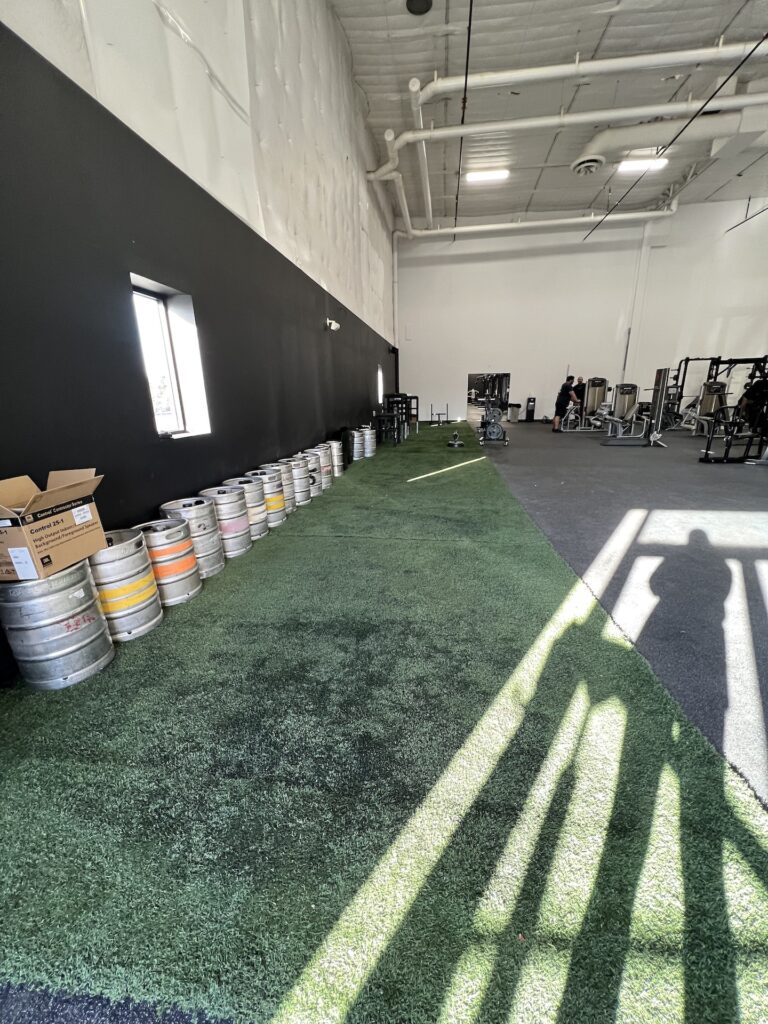

  • 5 steps to keep fitness progress
    5 Steps To Keep Progressing On Your Fitness Right Now
  • Thanksgiving friends at Big Tex Gym
    Thanksgiving Joy + Fitness Momentum (Yes, Both!)
  • Austin personal trainer Kathryn Alexander shares her clients' secret for successful holidays.
    My Clients’ Secret for Successful Holidays
  • Gifts for powerlifters: wrist wraps
    The Best Gifts for Powerlifters and What 1 Gift to Avoid
  • More Semi-Private Personal Training Options!
  • Quick Note: Exercise is Quality of Life

Filed Under: How To Tagged With: how to

How to Do Pushups

July 20, 2023 by Kathryn Alexander

Learn how to do pushups, and do pushups well, with these exercises and tips.

Pushups are one of the toughest exercises to do. The good news is that they are very trainable and if you work at them, you’ll improve and be able to do them. And, once you can do one string pushups, the others come fast!

Often, people practice pushups without paying attention to the nuances. This leads to a less than ideal setup, which actually makes them harder. 

how to do pushups
Kathryn Alexander, personal trainer in Austin, Texas, demonstrates pushups at Big Tex Gym.

What is the Ideal Form for Pushups? 

A pushup is a horizontal press. Think about if you were to try to push against a wall with the goal to move it. You’d want to exert as much force as you could straight into the wall. You wouldn’t push up toward the ceiling or press downward. You’d push straight forward. 

Apply this to pushups. You want your hands right under your chest (pushing away from you), not under your face, which would be like pushing up. Not pushing down, because then you’d fall on your face.

How to do a Pushup

Start with your hands a little wider than shoulder width, and spread your fingers out. Get a good grip on the ground. 

In this position, your elbows will be slightly tucked; not right by your side, and not out wide at shoulder width.

From the start position at the top, whether you are pushing from knees or feet, think about squeezing your shoulders down away from your ears. Keep this lats-tight position the whole time. 

Extend your head straight so your neck is a natural extension of your spine. You’ll be looking at the floor from this position. 

Now with all that positioning clamped on, squeeze your abs, legs and glutes so you maintain this straight line all the way from head to knees, or feet. 

From here, bend the elbows and control the descent. Reach with your chest, not your chin! Don’t stick your face close to the floor! 

Keeping this straight line, push back to your start position. 

Whew! That’s a lot! A brief recap: 

  • hands under your chest and slightly wider than your shoulders
  • elbows should be slightly tucked
  • squeeze your whole body tight
  • head is an extension of your spine
  • bend your elbows to bring your chest to the floor and then push the floor away from you
  • reach with your chest

Modifications for an Easier Pushup

If a push-up is not doable for you right now, add in a modified push-up from a bar or countertop. Keep all the same points in mind: hands chest level, not face level. Body stays in a straight line with your position clamped on. And do not reach with your face. Neck stays in line and reach with your chest! 

Next, add in some push-up negatives.

How to do Pushup Negatives

  • position your hands under your chest and slightly wider than your shoulders
  • elbows should be slightly tucked, not directly out from your shoulders
  • squeeze your armpits (lats) so your shoulders stay out of your ears and your back doesn’t sag
  • squeeze your glutes and legs
  • bend your elbows to bring your chest to the floor and then push the floor away from you
  • keep your head a natural extension of your spine and don’t reach your nose toward the floor
  • control your descent, going as slow as you’d like
  • try to touch the ground in a straight line, not like a worm
  • you can push up from your knees

These will be HARD! That’s ok! Remember that is where the progress is made! Fight fight fight to hit the ground in a straight line instead of your hips falling to the floor.

Building up your triceps strength will help too. Try skull crushers,  triceps pressdowns, overhead triceps extensions, and triceps kickbacks. Videos below.

How to Incorporate These Exercises

Add these in to your chest day or upper body pressing day. If you do full body sessions, which are great if you are training 3 days a week or fewer, then you’ll add the push-up work near the beginning of your session, and add triceps work in as assistance work (after your big lifts). 

If you are doing a push pull squat style training plan, you can incorporate pushups as the push. Read about how to plan that kind of training program here: push pull squat training.

Advice For Women Learning Pushups

Practice at pushups with the belief that you can do it! You can! I often hear women say that their upper body is weaker, and pushups are hard. They are hard! But you can develop the strength and ability to do them.

Practice these different pushup styles in this article, and also work on your triceps, which help tremendously with upper body pressing. Here’s a great article on tricep exercises for women. Practice these exercises and you’ll see your strength increase.

You can also make progress on your pushups by practicing other horizontal pressing exercises. Machine presses, barbell and dumbbell presses will increase your pushup strength.

What Rep Ranges Should I Use?

Consider the push-up and push-up negatives work as heavy strength work. This means you’ll get warmed up, and then work in sets of around 5 reps, where 5 reps are challenging. 

For your triceps work, do progressively heavier sets of 8-12 reps. Challenge yourself to increase your weight, which will usually mean decreasing reps. 

This will look like: 

Chest exercises:

  • Pushups from a bar or countertop: 4×5-8
  • Push-up negatives: 4×5

Triceps exercises (pick at least 2):

  • Overhead triceps extensions: 4×8-12
  • Skullcrushers: 4×8-12
  • Triceps pressdowns: 4×8-12
  • Triceps kickbacks: 4×8-12; here is an in-depth how-to on the triceps kickbacks

Strengthening your whole core will help with your pushups. Here are some of my favorite exercises to help strengthen your core.

You’ll be adding these in to your additional chest work, so remember to make time for it. It’ll be worth it! Need some inspiration for leg work? Try these quad exercises from home.

Let me know how your pushups practice goes! Work work work at it and keep going! If you get stumped and need more help, please reach out to me! kathryn@kathrynalexander.com.


About the author

Kathryn Alexander is a strength coach and personal trainer in Austin, Texas. She loves hiking, college football, and the feel of a perfectly knurled barbell. Read more about Kathryn here.
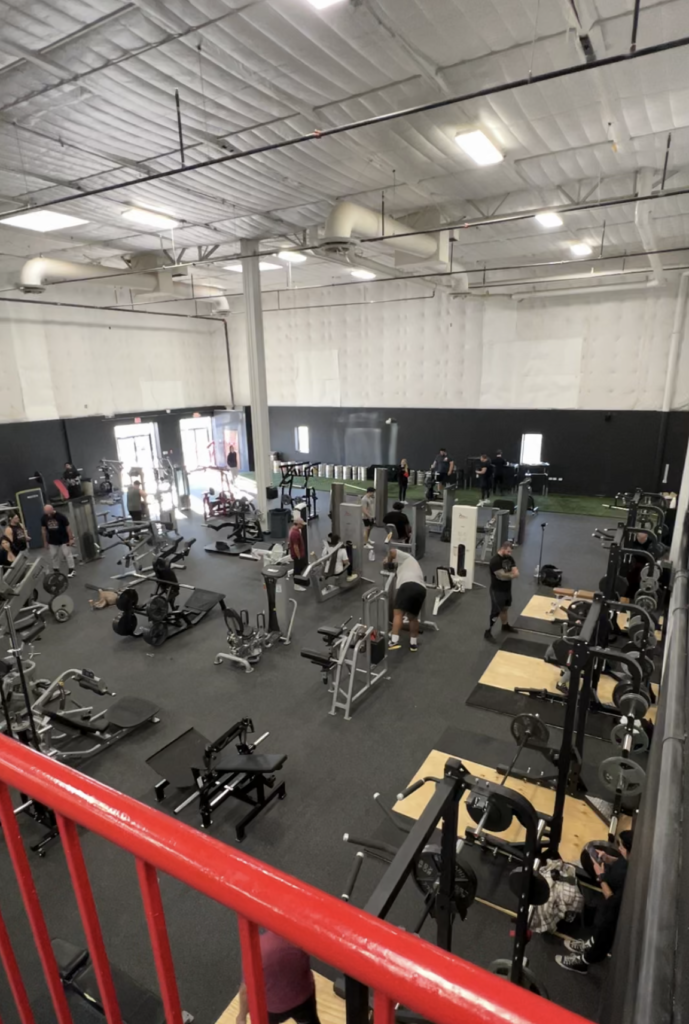

  • 5 steps to keep fitness progress
    5 Steps To Keep Progressing On Your Fitness Right Now
  • Thanksgiving friends at Big Tex Gym
    Thanksgiving Joy + Fitness Momentum (Yes, Both!)
  • Austin personal trainer Kathryn Alexander shares her clients' secret for successful holidays.
    My Clients’ Secret for Successful Holidays
  • Gifts for powerlifters: wrist wraps
    The Best Gifts for Powerlifters and What 1 Gift to Avoid
  • More Semi-Private Personal Training Options!
  • Quick Note: Exercise is Quality of Life

Filed Under: How To Tagged With: how to

Does Alcohol Make You Gain Weight?

July 19, 2023 by Kathryn Alexander

We have all heard the term beer belly and made jokes about getting a little belly from drinking habits, but in reality, does alcohol make you gain weight? 

The quick answer is, it can. Drinking alcohol does quickly add calories into your diet, and it is easy to consume a lot of them! There are many factors for whether or not you gain weight if you drink, because the human body is pretty complicated, so read along and see how alcohol consumption affects your weight gain or loss.

does alcohol make you gain weight?
Does drinking make you gain weight? Maybe so! Here’s a little Texas tequila cheers.

How Many Calories Are in Alcohol?

Alcohol is fairly calorically dense. There are 7 calories in each gram of alcohol. For reference, there are 4 calories in each gram of protein and carbs, and 9 calories in each gram of fat. (These are kilocalories, which is what you think of when you see nutrition labels). 

Calories per gram of macronutrient:

  • Carbs: 4 calories per gram
  • Protein: 4 calories per gram
  • Fat: 9 calories per gram
  • Alcohol: 7 calories per gram

This 7 calories per gram only refers to the alcohol content. This doesn’t even count the calories in the rest of the drink. A sweet margarita will have all the sugar calories as well, for example. 

I had a nutrition professor in my undergrad classes who said, “Drinking alcohol is like drinking cooking oil.” BLEH. What a visual! 

Alcohol calories aren’t good for you in any way. Calories from the other macronutrients (protein, fats and carbs) are building blocks in your body. When you consume the macronutrients, you are also taking in micronutrients, such as vitamins and minerals. Alcohol unfortunately doesn’t have any redeeming nutritional value.

Happy New Year! Read this how to for bulletproof ideas for New Year fitness resolutions.

Why Does Alcohol Make You Gain Weight? 

We know that on a large level, alcohol consumption disrupts other processes happening in the body. The body prioritizes breakdown alcohol rather than the other metabolic tasks it was working on, such as burning fat. Steiner, et. al do a great job explaining how alcohol affects fat metabolism, increases inflammation, and can results in gain fat, especially at the midsection. 

The takeaway is that alcohol adds to the stresses on the body and increase inflammation. 

How The Body Gains Weight

Remember earlier I said that there are many many factors behind weight loss or gain? Let’s discuss that now. The human body does work on a Calories In, Calories Out (CICO) model. The rate at which you burn calories is your metabolism. Metabolism is affected by many factors, including type, duration, and intensity of exercise, amount of muscle maintained, sleep, stress, health of the body in general. 

The amount of calories in, of course, is how many foods and drinks you consume. Whether you are counting or not, your body is. I don’t always advise counting, and you don’t have to count calories or macros to see progress. But know that your body is of course registering the calories you take in. 

Calories out is affected by the speed of your metabolism and how much you exert yourself. You’ll be burning calories at rest, and then burning more as you move and exercise. 

does drinking cause beer belly?
I tried my hand at brewing beer. Turns out, it wasn’t very tasty.

Is the Beer Belly a Real Thing? 

Yes and no. Drinking beer in excess can absolutely lead to belly fat gain. Beer is 150-300 calories per 12 ounce serving, and beers are fairly easy to drink quickly. Is this weight gain exclusive to beer drinking though? No. Drinking any kind of alcoholic drink in excess can can a beer belly type fat gain.

How to Drink and Not Gain Weight

As you can see, whether you gain or lose weight is complicated, and it depends on the sum of all those things: metabolic rate, calories in, and calories out. This is why “does drinking make me fat” is a hard question to answer. You have to factor in the rest of your life, and how much you are eating, drinking and exercising. 

If you’d still like to drink and not gain weight, then make sure you are also eating well, and in the right proportions. 

A shot of liquor on the rocks will have fewer calories than a mixed drink, a glass of wine or a beer. But beware, it doesn’t have less alcohol. It just has fewer calories because it has fewer things mixed in. 

How Do I Track Alcohol Calories? 

If you are tracking your macros, how do you track your alcohol calories? I suggest that you consider alcohol calories carb calories. Let’s take, for example, my favorite beer: Pinthouse PIzza’s Electric Jellyfish IPA. The average IPA has about 200 calories per 12 ounces. Let’s say I have two of those. (And pizza, because that’s what you do at Pinthouse).

Since I had 400 calories total, we’ll call that 100 grams of carbs. That’s how I would track it. 

The math is: 200 calories x 2 beers = 400 calories. 

400 calories of carbs = 100 grams, because we know that 1g carbs = 4 calories.

Whew! 100 grams of carbs is a lot! I could have had 3 bananas, or a serving of pasta and bread. Again, if I was eating pizza, I’d probably have that in addition to the alcohol, and now you can see how it adds up so quickly.

Other Factors That Make You Gain Weight While Drinking

Like the previous example of just having a couple beers with a meal, you can see how eating and drinking add up. Drinking can also lower your inhibit and alter decision making. You might be great at stopping eating when you have had enough in real, sober life. But with a little buzz? Yahhh, you can absolutely finish that pizza! 

Lowering inhibitions and increasing hunger definitely lead to increased caloric consumption, not just from alcohol. This all adds to the Calories In side of the CICO equation. 

How Do I Drink Alcohol and Not Gain Weight? 

The answer here is to look at the sum of your habits. If you can drink in moderation, and are eating the right amount of food, and exercising in an amount that pushes your weight maintenance/loss in the right direction, then yes. In that case, you can drink and not gain weight. 

You can have straight drinks instead of fruity, sugar-added cocktails to keep down the calorie count too. 

All in all, if you are of drinking age and do not have a problem with excessive drinking, then yes, you can drink. You just have to know that it does not serve your health in any way. If, knowing that, having a drink is worth it to you, then by all means enjoy your drinks. It is like anything else: you have to know what the effects are and decide if this is worth it to you. 

Of course, this sounds awfully judgy, but I do not mean it to be. I enjoy drinking on occasion too. It does affect sleep my negatively, and I find I’m not as creative after I drink, so I don’t often drink on work nights anymore. 

Looking for sober fun? Here are some active things to do in North Austin.

So You Like to Drink

In this case, prioritize staying hydrated with good water, eating enough protein and healthy carbs and fats, and exercising. Focus on keeping your exercise program up: keep up that motivation and training. Need help finding a good one? I can help 🙂 Check out the programs you can jump into today, here!

References:

Alcohol, Adipose Tissue and Lipid Dysregulation

Steiner JL, Lang CH. Alcohol, Adipose Tissue and Lipid Dysregulation. Biomolecules. 2017; 7(1):16. https://doi.org/10.3390/biom7010016


About the author

Kathryn Alexander is a strength coach and personal trainer in Austin, Texas. She loves hiking, college football, and the feel of a perfectly knurled barbell. Read more about Kathryn here.
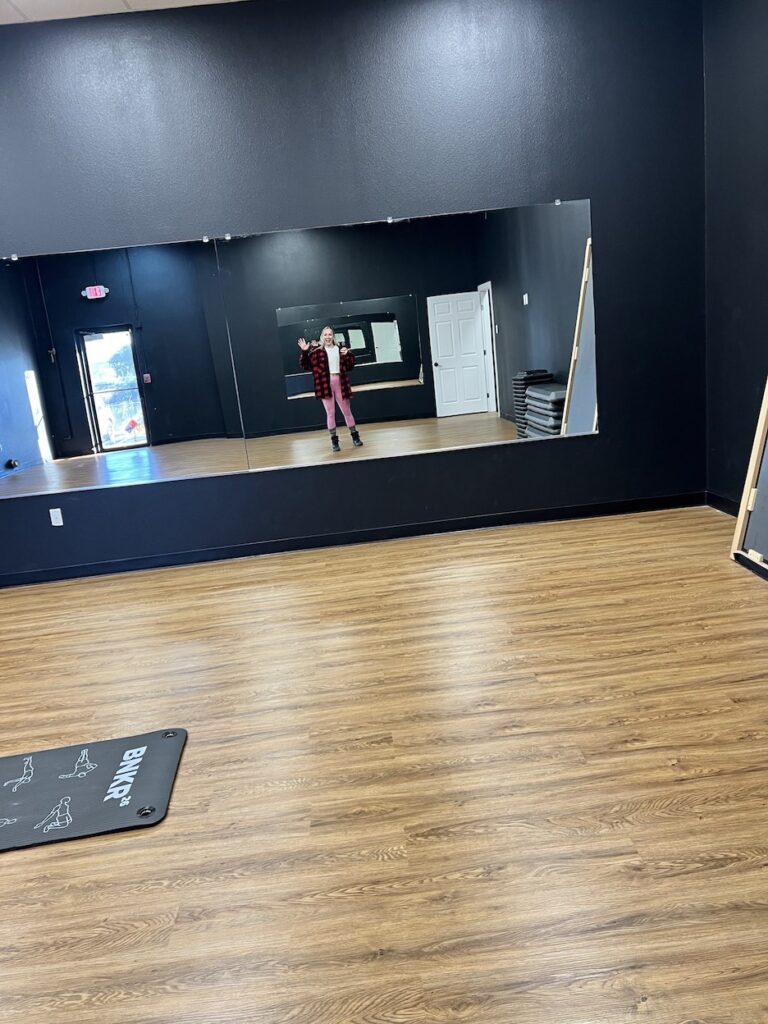

  • 5 steps to keep fitness progress
    5 Steps To Keep Progressing On Your Fitness Right Now
  • Thanksgiving friends at Big Tex Gym
    Thanksgiving Joy + Fitness Momentum (Yes, Both!)
  • Austin personal trainer Kathryn Alexander shares her clients' secret for successful holidays.
    My Clients’ Secret for Successful Holidays
  • Gifts for powerlifters: wrist wraps
    The Best Gifts for Powerlifters and What 1 Gift to Avoid
  • More Semi-Private Personal Training Options!
  • Quick Note: Exercise is Quality of Life

Filed Under: Nutrition & diet

Gym Mistakes to Avoid (and What to Do Instead)

July 17, 2023 by Kathryn Alexander

Gym mistakes to avoid and what to do instead, for continued progress. Working out can seem really complicated: lots of rules, lots of things to do, lots of mistakes that can be made. It’s actually not as scary or technical as it sounds.

Generally, you can do a few things well, and avoid a few major mistakes, to see the results you want. Here are a few of the more common mistakes and easy ways to avoid them.

Doing Too Much Exercise, Too Fast

Deciding to go to the gym and committing to a goal is exciting! It’s fun! You want to go all in, right now. This makes it fun to get started, see some quick progress, and keep going. Unfortunately, it also makes its easy to do too much too fast.

This includes working out too many days of the week and not resting enough, lifting too heavy, or doing too much volume (sets x reps) at the beginning. 

You don’t have to go to the gym everyday. You can do a program where you go 3 or so days a week. You can do cardio or walking on other days if you’d like.

Remember, you will reach your goals faster when you are able to work steady, and increase your work capacity in a safe way. Setbacks don’t help your progress! 

Find a good program, work hard, and stick with it. It will pay dividends!

Related: Read here about how to find the right program for you.

gym mistakes to avoid
Gym mistake to avoid: not thinking through outfits before photo shoots haha

Lifting With Bad Form

Don’t be scared of lifting, but do put in some work on the front end to be sure you are lifting safely. Bad form can slow progress or injure you. Remember there are many right ways to do exercises (depending on your goals), a few less-than-optimal ways, and a few dead-wrong. 

Lifting with less than optimal form can be fairly innocuous. It can leave some progress unmet, which is frustrating but fairly harmless. Worse, it can cause or reinforce bad posture, which you carry with you at all hours. This pre-dispose you to injury in the future.

Finally, truly bad form can be dangerous, since it can injure you. By lifting heavy with good form (safely), you will learn how to fail without injury. This helps you continue getting stronger in a safe manner. But lifting heavy with questionable form is more likely to cause a setback. It is worth learning how to lift well from a good trainer or reliable source.

Being Too Dogmatic/Limiting Yourself

Approaching exercise with the attitude that you know everything, and everything you know is right, is the quickest way to stagnation. 

Don’t be too stubborn to learn from others. You don’t have to chase down every new idea you see (in fact, I would recommend against that) but don’t shut out the idea that new information can help you now or in the future. 

What to Do Instead

Don’t let these things scare you off from the gym. See to it that you learn the right way to lift and take proper precautions. Learn good form, and how to modify it for your individual goals and needs. 

The benefits far outweigh the potential risks! Lifting can help you gain muscle, lose fat, reshape your body, sleep better, and find new energy! It can truly give you a new outlook on life. Try it and see for yourself!

If you are brand new, try Square 1, which is my lifting program that starts from the beginning. It includes tips about gym etiquette and walks you through every set and rep of each exercise. It is a 6 week long program for $21, and you can message me anytime you have a question.


About the author

Kathryn Alexander is a strength coach and personal trainer in Austin, Texas. She loves hiking, college football, and the feel of a perfectly knurled barbell. Read more about Kathryn here.
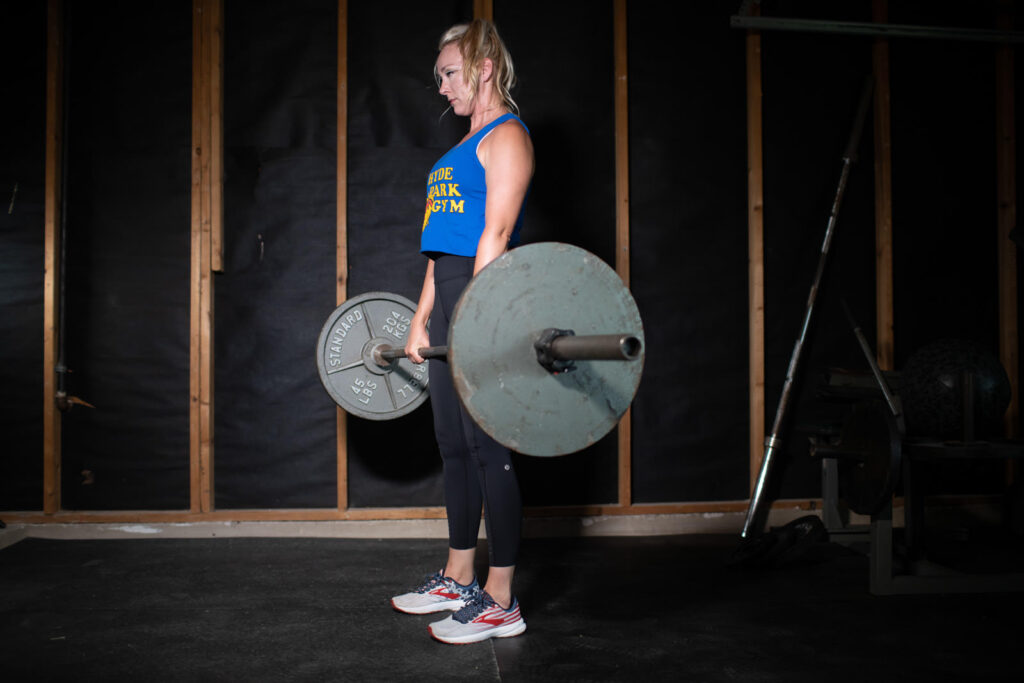

  • 5 steps to keep fitness progress
    5 Steps To Keep Progressing On Your Fitness Right Now
  • Thanksgiving friends at Big Tex Gym
    Thanksgiving Joy + Fitness Momentum (Yes, Both!)
  • Austin personal trainer Kathryn Alexander shares her clients' secret for successful holidays.
    My Clients’ Secret for Successful Holidays
  • Gifts for powerlifters: wrist wraps
    The Best Gifts for Powerlifters and What 1 Gift to Avoid
  • More Semi-Private Personal Training Options!
  • Quick Note: Exercise is Quality of Life

Filed Under: Attitude & Mindset

Austin Fit Fest

July 14, 2023 by Kathryn Alexander

The Austin Fit Fest is coming up on August 19 here in the capital city! Austin Fit Fest is a mashup of sports, competitions, vendors and exhibitions. There will be strongman, powerlifting, jiu jitsu, MMA, weightlifting, CrossFit, armored combat, wrestling, and more.

Austin Fit Fest MMA

United States Strongest

The United States Strongest, hosted by Big Tex Gym, Factory Gym, Iron Gym, and Lift ATX, will feature national qualifying strongman and powerlifting events. There will be over $5k in prizes from these competitions so you know competitors are ready to bring their A game and put on a show.

These two events will be worth the admission, alone! 

Check out this Austin Gift Guide (2024) to make your holiday shopping easy!

Austin Fit Fest United States Strongest

The strongman competition is a qualifier for US Strongman and powerlifting through WRPF. 

MMA

Mixed martial arts, jiu jitsu, and arm wrestling will be happening as well. These are fan favorites, and tickets are separate for the MMA, so be sure you are purchasing entry to the events you’d like. 

Armored Combat

Armored combat is a sport in which participants are clad in helmets and armor. They fight with swords and clubs. This will be a first for me! 

Austin Fit Fest armored combat

Austin Fit Fest Tickets

Tickets are $30 for general entry, $45 for MMA, and $75 for both. Kids 10 and younger are free. You can check out more info here at their website.

I’ll be there between the powerlifting and strongman so I hope to see you then! 

Other Austin Info

cheap fun things to do in Austin. Barton Springs Pool

Cheap, Fun Things to Do in Austin, Texas (2025)

Back to school sale personal training Austin

Back to School Sale!

Summer in Austin

This Summer in Austin

Kathryn Alexander Austin personal trainer

Let’s Lift! Personal Training Spots Open at Big Tex Gym

Tubing Near Austin Best Rivers in Texas

Tubing Near Austin: Best Rivers in Texas (2025)

semi private personal training Austin Texas

New Semi Private Personal Training in Austin, Texas!

Outdoor Recreation in Austin

If you are inspired by these out of the box sports and looking to get outside for some movement, check out this post about the 5 best parks in Austin for outdoor recreation.


About the author

Kathryn Alexander is a strength coach and personal trainer in Austin, Texas. She loves hiking, college football, and the feel of a perfectly knurled barbell. Read more about Kathryn here.
Filed Under: Austin Tagged With: Austin

  • « Go to Previous Page
  • Go to page 1
  • Go to page 2
  • Go to page 3
  • Go to page 4
  • Go to page 5
  • Go to page 6
  • Go to page 7
  • Go to Next Page »

Primary Sidebar

Kathryn Alexander, personal trainer in Austin
Hi, and welcome here! -Kathryn

Did you know I make custom training plans? Tell Me More!

Recent Posts

  • 5 Steps To Keep Progressing On Your Fitness Right Now
  • Thanksgiving Joy + Fitness Momentum (Yes, Both!)
  • My Clients’ Secret for Successful Holidays
  • The Best Gifts for Powerlifters and What 1 Gift to Avoid
  • More Semi-Private Personal Training Options!

Footer

Follow

  • Email
  • Instagram
  • YouTube

Affiliate disclaimer

As an Amazon Associate I earn from qualifying purchases.
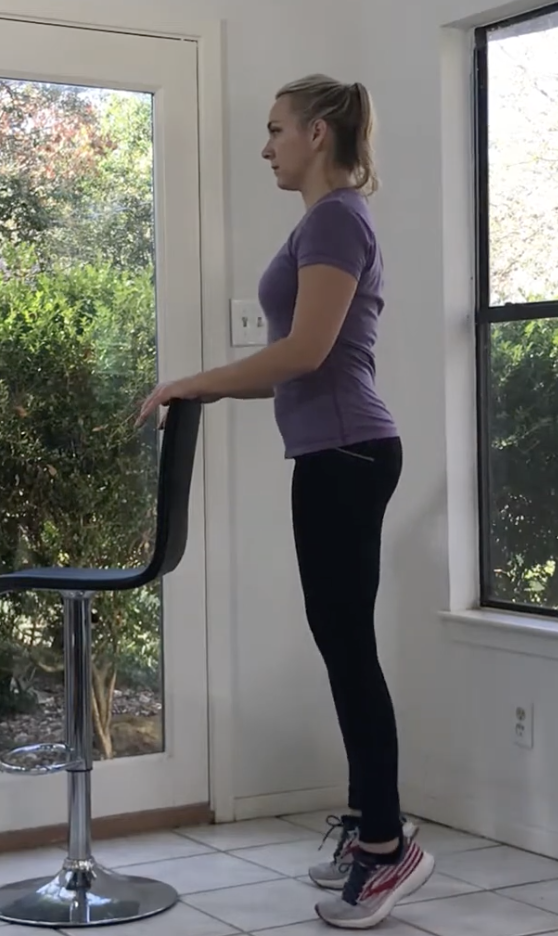
Newsletter sign up

  • Home
  • About Kathryn Alexander
  • Blog
  • Success Stories
  • Training Programs
  • Start Today

Copyright © 2025 · Genesis Sample on Genesis Framework · WordPress · Log in

  • Featured In
  • Privacy Policy
  • Resources
  • Online Personal Training
  • Personal Training
  • Training Programs